Biteback wins rights to Campbell diaries - Iain Dale
Algerian Diary - West Virginia University Press, Star Tribune
Diary of a company controller - The Virginian Pilot
Top of the Pops girl’s diary - The Mirror
The Private Life of the Diary - Unbound, The Independent
Split WWII refugee tales - Total Croatia News
NZ’s first weather diaries - Voxy
Diary of Germanwings pilot - Deutsche Welle
Monday, March 28, 2016


Thursday, March 24, 2016
Lost behind my camera
‘I face the fact that I find myself really happy only when I am lost behind my camera or locked in my dark-room. So today I became happy for a while: I photographed more of my “juguetes Mexicanos”, this time the “pajaritos” - little birds - in blue, - exquisite things in line.’ This is Edward Weston born 130 years ago today. He was one of the most influential of 20th century photographers, and he was no mean diarist either. His so-called daybooks, covering his Mexico period and several years after, are rightly regarded as unique documents, not only for the detail they provide of his colourful life, but for the way they show how his artistic style, his photographic creativity, developed over time.

Weston was born on 24 March 1886 in Highland Park, Illinois, to a surgeon and his actress wife. His mother died when he was but five years old, and he was looked after, mostly, by his older sister, Mary, though their father did remarry. Aged 16, he was given his first camera, and began spending much of his free time taking photographs. He left school early, and took a job in a department store. A few weeks after his 20th birthday, Camera and Darkroom published Weston’s picture Spring, Chicago - the first known publication of any of his photographs.
That same year Weston left the Chicago area to live near his sister who had moved to Tropico (now Glendale), California, though he returned to Illinois for several months to study at a photography school. In 1909, he married his sister’s best friend, Flora Chandler, a teacher who was several years older than him but who was part of a wealthy family. They would have four sons together. Having worked in photography studios for several years, Weston now began working full-time as a photographer. In 1911, he started his own business in Tropico, The Little Studio, taking commissioned photographic portraits. With very high standards for his own work, he soon made a name for himself, winning prizes, publishing photographs in specialised magazines, and being invited to stage one-man shows.
Weston’s work at this stage was considered to be in the pictorial style, imitating Impressionist painting by suppressing detail in the darkroom, but it would not be long before he moved away from atmospheric effects, towards realism, and a new emphasis on abstract form and sharp resolution of detail. In particular, he developed a technique that concentrated on the image as seen, eschewing any later darkroom manipulation.
In 1913, Weston met the photographer Margrethe Mather, a liberated Bohemian, and began an intense affair. She became his studio assistant, and then some years later, his business partner. She was the first person, apart from his family, that he photographed in the nude, starting around 1920. That year, he met a Los Angeles couple Roubaix de l’Abrie Richey, known as Robo, and the actress, Tina Modotti. With Richey’s knowledge, Weston carried on an affair with Modotti, who also modelled for him in the nude, and became his main model for several years thereafter. Meanwhile, Weston visited New York and photographers there, being much encouraged by the great Alfred Stieglitz.
Soon after Weston’s return form the east coast, Richey moved to Mexico City to set up a batik workshop. He was arranging a joint exhibition for his work and Weston’s when he contracted smallpox. Modotti when to join him but by the time she arrived, Richey had died. She decided to continue with the exhibition. It proved a success, and established Weston’s reputation there, leading him to spend most of the next few years in Mexico, mostly with Modotti, but also sometimes with one or other of his sons, holding exhibitions, travelling round the country taking photographs of many ordinary objects, but also folk craft, and generally strengthening his artistic reputation. When his relationship with Modotti finished, he returned finally to California in 1926.
Now, Weston turned to large scale close-ups of natural objects, such as shells, vegetables (see Pepper No. 30), trees, revelling in the textures, and to a more abstract form in his nudes. He, and his son Brett, moved to a studio in San Francisco but then settled a little further south in Carmel. In 1929, he met the photographer Sonya Noskowiak who became his muse, and stayed with him for five years. The Art of Edward Weston, a first book exclusively devoted to his work, was published in 1932. The same year, he formed, with other photographers, Group f/64, which held a critically successful exhibition at the De Young Museum. In 1934, a new love - Charis Wilson - replaced Noskowiak, and a nude of Wilson taken in 1936 would become one of Weston’s most famous photographs. Around this time, he and Brett again moved, this time to set up a studio in Santa Monica Canyon.
In 1937, Weston became the first photographer to receive a prestigious Guggenheim grant, which eased his ongoing financial problems, and led to publication, in 1939, of Seeing California with Edward Weston, written by Wilson. The same year, he married Wilson, and the following year they published together California and the West. Subsequently, Weston was invited to illustrate a new edition of Walt Whitman’s Leaves of Grass, which led him to travel thousands of miles, and take many hundreds of photographs, of which 49 were selected for the book. From 1945, Weston began to suffer from Parkinson’s Disease. A major retrospective of his work opened at the Museum of Modern Art in 1946, by which time he and Wilson had separated. Weston’s last years were spent organising his negatives, and selecting images for exhibition or publication. He died in 1958. Further information is readily available online, at the official Edward Weston site, at Kim Weston’s website (Kim being Edward’s grandson), Wikipedia, and Encyclopaedia Britannica.
For many years - until he met Charis Wilson in fact - Weston kept a diary, or, as he called them, daybooks. He is known, however, to have destroyed diaries that he kept prior to going to Mexico, leaving no trace of them. He also burned his Mexico diaries, but not before editing them and having a typescript made. It is this typescript, edited by Nancy Newhall, while Weston was still alive and with his approval, that was published in 1961 by The George Eastman House as The Daybooks of Edward Weston, Volume I - Mexico. George Eastman House announced publication of the first volume in its bulletin, Image, saying: ’Seldom has an artist written about his life and art as vividly, as intimately and as sensitively. We know of nothing comparable in the literature of photography. [. . .] Day after day Edward Weston wrote down his thoughts about life and photography, outlined his hopes, catalogued his despairs, mercilessly criticized his photographs, and recorded every experience which moved him.’

Newhall, in the first volume, gives a firsthand account of how Weston’s daybooks came to be published: ‘The Mexican period exists now only in a typescript badly done sometime in the late 1930s or early 40s: “Yes, the MS was ‘monkeyed with’ by a German girl. It was supposedly just copied... In my original copy, which was longhand, the punctuation was dashes - (‘modern’) - Since the first typewritten copy, each person has punctuated, paragraphed and spelled according to heart’s desire.” Edward burned the original MS; he had already cut from what the various typists received nearly all references to the agony he suffered over Tina Modotti’s other lovers; nothing at all remains of his agony over his eldest son, Chandler, a thirteen-year caught first in the cross-fire between his mother and father, then in the crossfire between Tina and Edward. What remains of the Daybook in this period, battered and twisted as it is by the German girl’s attempts to give it a romantic Goethean style, is still valid. I have cut only redundancies - the parties, the bullfights, the Mexican toys which in the original become monotonous, - and a few vulgarities and sentimentalities of the kind Edward could no longer stand: “Reading, for example, such lines as ‘I drew close to her and kissed her’ shivers me, makes me out a pretentious prig. I can’t take it! Seeing it in a book would turn me into a hermit. Is there much of that stuff?…Otherwise he thought it “not too bad - except when I try to write.” The years in Mexico were only the beginning. “Did I tell you that I have eight years of Day Book, post Mexico? Memory tells me it makes the Mexican period seem pallid.” He was right, and here, though it has suffered heavily from his razor, we have the original MS in his massive scrawl. It is briefer, more incisive; his passion like fire eats at what in him was unessential to his purpose: “to present clearly my feeling for life with photographic beauty... without subterfuge or evasion in spirit or technique.” ’
The second volume - The Daybooks of Edward Weston, Volume II - California - appeared in 1966, and together with the first volume are a remarkable, extraordinary record not only of a great artist’s private life, but of the detailed progress and development of his art, his artistic genius. Here are several extracts from Volume I.
1 November 1924
‘The exhibit is over. The naked balcony walls presented a sad and stripped void as we glanced back to be assured no print was forgotten; but no time for tears, for already a new exhibit is on! Tina and I for the first time are showing together; indeed, it is her first public showing, and I am proud of my dear “apprentice.” We went directly from the “Aztec Land” and under the auspices of the Secretaria de Education Publica hung ten prints each in the Palacio de Mineria. It is a big affair: Rafael, Chariot, Felipe among our friends are also showing.’
2 November 1924
‘El Dia de los Muertos. Like mushrooms magically appearing over night, los puestos - in celebration of the Day of the Dead - once more are with us. More numerous, more varied than ever, they line both sides of two blocks and the street centres as well, I wondered and searched untiringly for my occasional concrete reward; this time I found more “Mexican porcelains” - animales de barro - clay animals - a magenta-colored dog mouthing a green basket, excellent in form, and, at the same booth, a wildcat biting into a green snake . . . [. . .]
Yesterday, with the band’s salute, President Obregon formally opened the exhibit at the Palacio de Mineria. Our photographs are simply and well displayed. Tina’s lose nothing by comparison with mine - they are her own expression.
Sunday Evening. D. H. Lawrence, English author and poet, in with Louis Quintanilla. My first impression was a most agreeable one. He will sit for me Tuesday.’
3 November 1924
‘After experiencing the ever-recurrent condition of being “broke”, I have sold two prints: “Palma Cuernavaca”, and a nude; besides, I have four definite dates for sittings. Such prosperity is overwhelming! Tomorrow I dine at a luncheon in honor of the United States Ambassador to Mexico. God knows his name - I don’t - but duty calls. In preparation I trimmed the fringe from my trousers and borrowed a hat from Rafael. Now to buy a collar and I shall be ready for the fray.’
4 November 1924
‘The sitting of D. H. Lawrence this morning. A tall, slender, rather reserved individual with a brick-red beard. He was amiable enough and we parted in a friendly way, but the contact was too brief for either of us to penetrate more than superficially the other: no way to make a sitting.’
21 November 1924
‘To Fronton - Juego de Pelota - with Pepe, Chandler and Tina. “You may find it more thrilling than ‘los toros’,” said Pepe. I did not, though it was exciting, to be sure - a game to make, by contrast, our tennis and baseball appear quite tame. The Latins evolve sports that are spectacular, sensational, dangerous, and always elegant. Every second of the play was scintillating; one fairly gasped as the pelota shot through the air like a bullet while the players executed most miraculous passes, involving dramatically tense and beautiful postures.
Preceding our departure for Fronton, a surprise was afforded us by the arrival of Chariot, Nahui Olin, Federico, Anita and several bottles of wine. They had come to celebrate! And this is why - at the recent exhibit in the Palacio de Mineria, I was awarded first prize for photographs (one hundred and fifty pesos)! Quite unbelievable. I shall await undue enthusiasm until the money is collected. The honor of winning amounts to nothing: we had no real competition. Diego Rivera was on the jury, who else I know not.’
24 November 1924
‘Sunday in the “Secretaria” patio I made two dozen Graflex negatives of Diego Rivera. As yet they remain undeveloped. Also started an undertaking which I have already given up, that of copying his work for reproduction in a book to be published about him in Germany. It looms as too great a task without ample renumeration, which is uncertain. There are some who feel that Diego’s work is too calculated, too entirely a product of his brain. For me it is emotional as well as intellectual. For a man to paint murals twelve hours a day - sometimes even sixteen hours at a stretch - and day after day working quite as a day-laborer might, not awaiting “mood” or “inspiration”, it is amazing to me how much feeling he attains in his work. Only a man of great physical strength, possessed of a brilliant mind and a big heart as well, could have done what Diego has.
Yesterday I felt, as I have before, the preoccupation of his work. Direct questions were often entirely unheard, his eyes would be utterly oblivious to surroundings - then suddenly he would start out of himself, break into a broad, genial smile, and for a few moments Diego the dreamer was gone.’
25 November 1924
‘I said to Tina, having noted several interesting items in a downtown bookstore, “Let us go on a book-hunting expedition, I am hungry for a new thrill.” We were successful in acquiring a number of additions to our library, mostly books reproducing the work of contemporary painters. Ferat, Grosz, Dérain, and a volume on African sculpture - what splendid things! - and how fine is Derain!
Now my orders are printed and the stage set for more sittings. It will take many orders to pay the expenses of our return trip.’
29 November 1924
‘Diego, refering to my head of Galván, said, “Es un retrato - portrait - de Mexico.”
I cannot work in such feverish haste as I do with my Graflex and register quite the critical definition desired. F/ll is the smallest stop possible to use without undertiming when making portrait heads in the sun, - setting the shutter at 1/10 second and using panchromatic films, - thus when depth is required my difficulties are increased. Diego’s ample belly as he sat on a packing box in the Secretaria patio, swelled forward quite like a woman pregnant, presenting much difficulty.
Jean thinks they are the most interesting set of proofs from a sitting that I have done in Mexico. Well - I do like some of them, yes, a number of them, yet I could wish, especially with Diego, that I had made something to be very enthusiastic over. In each proof I find a fault, granted a minor one, and I had hoped for a quite perfect negative from this sitting, not just because Diego is a big artist, rather because he is especially interested in my work.
Last evening we went to a “studio tea” at Fred Davis’s home: a genial host, delicious food and drink, many beautiful things, mixed to be sure with an overwhelming number of bad ones. But I am impatient, I cannot enjoy social gatherings; the meeting with a few friends, one or two at a time, is the only form of contact that appeals to me.
I face the fact that I find myself really happy only when I am lost behind my camera or locked in my dark-room. So today I became happy for a while: I photographed more of my “juguetes Mexicanos”, this time the “pajaritos” - little birds - in blue, - exquisite things in line. I combined two of them on my ground glass. Perhaps three negatives will be considered worth printing. Martial music, - soldiers pass below, - a bedraggled lot but with brave front: not to be denied, dogs of sorry mien march with the procession somewhat lowering its essayed dignity. Tonight Chapultepec Castle is a blaze of light. - All this is preparation, for tomorrow is Calles inauguration.
Surely here in Mexico we live in another world for Thanksgiving Day was passed quite unremembered! - perhaps it should have been.’
30 November 1924
‘Technically dissatisfied with what should have been my best photograph of “los pajaritos”, I spent another several hours attempting to duplicate it: impossible to place even inanimate objects exactly as seen before. I still think my failure the best seen negative though the actual difference is ever so slight.’
2 December 1924
‘In the same way that I ruined part of my last sitting of Tina done two months ago, I fogged today’s by turning on the white light during the development. It almost seems that fate has decreed against my doing what I wish to do in the way of portraying Tina. But one of the negatives made this morning pleases me: the glare of light on the azotea destroyed all the delicate modulations in Tina’s face. It was flat and uninteresting, - too, the eyes were filled with unpleasant catch lights. I must call the sitting a failure. We shall try again tomorrow.
After ordering prints on our exchange, amounting to 230 pesos, Mr. Fred Davis intimated that he would like at least four or five more prints, so I shall have clothing to the value of some 380 pesos. Good luck indeed!
Tomorrow a big day: in the morning Tina again, in the afternoon Jean Chariot. Diego was pleased with his proofs. They are, I will say, well seen. His choice was one in which his huge bulk was exaggerated, and his face expressed a cynical sadness.’

Weston was born on 24 March 1886 in Highland Park, Illinois, to a surgeon and his actress wife. His mother died when he was but five years old, and he was looked after, mostly, by his older sister, Mary, though their father did remarry. Aged 16, he was given his first camera, and began spending much of his free time taking photographs. He left school early, and took a job in a department store. A few weeks after his 20th birthday, Camera and Darkroom published Weston’s picture Spring, Chicago - the first known publication of any of his photographs.
That same year Weston left the Chicago area to live near his sister who had moved to Tropico (now Glendale), California, though he returned to Illinois for several months to study at a photography school. In 1909, he married his sister’s best friend, Flora Chandler, a teacher who was several years older than him but who was part of a wealthy family. They would have four sons together. Having worked in photography studios for several years, Weston now began working full-time as a photographer. In 1911, he started his own business in Tropico, The Little Studio, taking commissioned photographic portraits. With very high standards for his own work, he soon made a name for himself, winning prizes, publishing photographs in specialised magazines, and being invited to stage one-man shows.
Weston’s work at this stage was considered to be in the pictorial style, imitating Impressionist painting by suppressing detail in the darkroom, but it would not be long before he moved away from atmospheric effects, towards realism, and a new emphasis on abstract form and sharp resolution of detail. In particular, he developed a technique that concentrated on the image as seen, eschewing any later darkroom manipulation.
In 1913, Weston met the photographer Margrethe Mather, a liberated Bohemian, and began an intense affair. She became his studio assistant, and then some years later, his business partner. She was the first person, apart from his family, that he photographed in the nude, starting around 1920. That year, he met a Los Angeles couple Roubaix de l’Abrie Richey, known as Robo, and the actress, Tina Modotti. With Richey’s knowledge, Weston carried on an affair with Modotti, who also modelled for him in the nude, and became his main model for several years thereafter. Meanwhile, Weston visited New York and photographers there, being much encouraged by the great Alfred Stieglitz.
Soon after Weston’s return form the east coast, Richey moved to Mexico City to set up a batik workshop. He was arranging a joint exhibition for his work and Weston’s when he contracted smallpox. Modotti when to join him but by the time she arrived, Richey had died. She decided to continue with the exhibition. It proved a success, and established Weston’s reputation there, leading him to spend most of the next few years in Mexico, mostly with Modotti, but also sometimes with one or other of his sons, holding exhibitions, travelling round the country taking photographs of many ordinary objects, but also folk craft, and generally strengthening his artistic reputation. When his relationship with Modotti finished, he returned finally to California in 1926.
Now, Weston turned to large scale close-ups of natural objects, such as shells, vegetables (see Pepper No. 30), trees, revelling in the textures, and to a more abstract form in his nudes. He, and his son Brett, moved to a studio in San Francisco but then settled a little further south in Carmel. In 1929, he met the photographer Sonya Noskowiak who became his muse, and stayed with him for five years. The Art of Edward Weston, a first book exclusively devoted to his work, was published in 1932. The same year, he formed, with other photographers, Group f/64, which held a critically successful exhibition at the De Young Museum. In 1934, a new love - Charis Wilson - replaced Noskowiak, and a nude of Wilson taken in 1936 would become one of Weston’s most famous photographs. Around this time, he and Brett again moved, this time to set up a studio in Santa Monica Canyon.
In 1937, Weston became the first photographer to receive a prestigious Guggenheim grant, which eased his ongoing financial problems, and led to publication, in 1939, of Seeing California with Edward Weston, written by Wilson. The same year, he married Wilson, and the following year they published together California and the West. Subsequently, Weston was invited to illustrate a new edition of Walt Whitman’s Leaves of Grass, which led him to travel thousands of miles, and take many hundreds of photographs, of which 49 were selected for the book. From 1945, Weston began to suffer from Parkinson’s Disease. A major retrospective of his work opened at the Museum of Modern Art in 1946, by which time he and Wilson had separated. Weston’s last years were spent organising his negatives, and selecting images for exhibition or publication. He died in 1958. Further information is readily available online, at the official Edward Weston site, at Kim Weston’s website (Kim being Edward’s grandson), Wikipedia, and Encyclopaedia Britannica.
For many years - until he met Charis Wilson in fact - Weston kept a diary, or, as he called them, daybooks. He is known, however, to have destroyed diaries that he kept prior to going to Mexico, leaving no trace of them. He also burned his Mexico diaries, but not before editing them and having a typescript made. It is this typescript, edited by Nancy Newhall, while Weston was still alive and with his approval, that was published in 1961 by The George Eastman House as The Daybooks of Edward Weston, Volume I - Mexico. George Eastman House announced publication of the first volume in its bulletin, Image, saying: ’Seldom has an artist written about his life and art as vividly, as intimately and as sensitively. We know of nothing comparable in the literature of photography. [. . .] Day after day Edward Weston wrote down his thoughts about life and photography, outlined his hopes, catalogued his despairs, mercilessly criticized his photographs, and recorded every experience which moved him.’

Newhall, in the first volume, gives a firsthand account of how Weston’s daybooks came to be published: ‘The Mexican period exists now only in a typescript badly done sometime in the late 1930s or early 40s: “Yes, the MS was ‘monkeyed with’ by a German girl. It was supposedly just copied... In my original copy, which was longhand, the punctuation was dashes - (‘modern’) - Since the first typewritten copy, each person has punctuated, paragraphed and spelled according to heart’s desire.” Edward burned the original MS; he had already cut from what the various typists received nearly all references to the agony he suffered over Tina Modotti’s other lovers; nothing at all remains of his agony over his eldest son, Chandler, a thirteen-year caught first in the cross-fire between his mother and father, then in the crossfire between Tina and Edward. What remains of the Daybook in this period, battered and twisted as it is by the German girl’s attempts to give it a romantic Goethean style, is still valid. I have cut only redundancies - the parties, the bullfights, the Mexican toys which in the original become monotonous, - and a few vulgarities and sentimentalities of the kind Edward could no longer stand: “Reading, for example, such lines as ‘I drew close to her and kissed her’ shivers me, makes me out a pretentious prig. I can’t take it! Seeing it in a book would turn me into a hermit. Is there much of that stuff?…Otherwise he thought it “not too bad - except when I try to write.” The years in Mexico were only the beginning. “Did I tell you that I have eight years of Day Book, post Mexico? Memory tells me it makes the Mexican period seem pallid.” He was right, and here, though it has suffered heavily from his razor, we have the original MS in his massive scrawl. It is briefer, more incisive; his passion like fire eats at what in him was unessential to his purpose: “to present clearly my feeling for life with photographic beauty... without subterfuge or evasion in spirit or technique.” ’
The second volume - The Daybooks of Edward Weston, Volume II - California - appeared in 1966, and together with the first volume are a remarkable, extraordinary record not only of a great artist’s private life, but of the detailed progress and development of his art, his artistic genius. Here are several extracts from Volume I.
1 November 1924
‘The exhibit is over. The naked balcony walls presented a sad and stripped void as we glanced back to be assured no print was forgotten; but no time for tears, for already a new exhibit is on! Tina and I for the first time are showing together; indeed, it is her first public showing, and I am proud of my dear “apprentice.” We went directly from the “Aztec Land” and under the auspices of the Secretaria de Education Publica hung ten prints each in the Palacio de Mineria. It is a big affair: Rafael, Chariot, Felipe among our friends are also showing.’
2 November 1924
‘El Dia de los Muertos. Like mushrooms magically appearing over night, los puestos - in celebration of the Day of the Dead - once more are with us. More numerous, more varied than ever, they line both sides of two blocks and the street centres as well, I wondered and searched untiringly for my occasional concrete reward; this time I found more “Mexican porcelains” - animales de barro - clay animals - a magenta-colored dog mouthing a green basket, excellent in form, and, at the same booth, a wildcat biting into a green snake . . . [. . .]
Yesterday, with the band’s salute, President Obregon formally opened the exhibit at the Palacio de Mineria. Our photographs are simply and well displayed. Tina’s lose nothing by comparison with mine - they are her own expression.
Sunday Evening. D. H. Lawrence, English author and poet, in with Louis Quintanilla. My first impression was a most agreeable one. He will sit for me Tuesday.’
3 November 1924
‘After experiencing the ever-recurrent condition of being “broke”, I have sold two prints: “Palma Cuernavaca”, and a nude; besides, I have four definite dates for sittings. Such prosperity is overwhelming! Tomorrow I dine at a luncheon in honor of the United States Ambassador to Mexico. God knows his name - I don’t - but duty calls. In preparation I trimmed the fringe from my trousers and borrowed a hat from Rafael. Now to buy a collar and I shall be ready for the fray.’
4 November 1924
‘The sitting of D. H. Lawrence this morning. A tall, slender, rather reserved individual with a brick-red beard. He was amiable enough and we parted in a friendly way, but the contact was too brief for either of us to penetrate more than superficially the other: no way to make a sitting.’
21 November 1924
‘To Fronton - Juego de Pelota - with Pepe, Chandler and Tina. “You may find it more thrilling than ‘los toros’,” said Pepe. I did not, though it was exciting, to be sure - a game to make, by contrast, our tennis and baseball appear quite tame. The Latins evolve sports that are spectacular, sensational, dangerous, and always elegant. Every second of the play was scintillating; one fairly gasped as the pelota shot through the air like a bullet while the players executed most miraculous passes, involving dramatically tense and beautiful postures.
Preceding our departure for Fronton, a surprise was afforded us by the arrival of Chariot, Nahui Olin, Federico, Anita and several bottles of wine. They had come to celebrate! And this is why - at the recent exhibit in the Palacio de Mineria, I was awarded first prize for photographs (one hundred and fifty pesos)! Quite unbelievable. I shall await undue enthusiasm until the money is collected. The honor of winning amounts to nothing: we had no real competition. Diego Rivera was on the jury, who else I know not.’
24 November 1924
‘Sunday in the “Secretaria” patio I made two dozen Graflex negatives of Diego Rivera. As yet they remain undeveloped. Also started an undertaking which I have already given up, that of copying his work for reproduction in a book to be published about him in Germany. It looms as too great a task without ample renumeration, which is uncertain. There are some who feel that Diego’s work is too calculated, too entirely a product of his brain. For me it is emotional as well as intellectual. For a man to paint murals twelve hours a day - sometimes even sixteen hours at a stretch - and day after day working quite as a day-laborer might, not awaiting “mood” or “inspiration”, it is amazing to me how much feeling he attains in his work. Only a man of great physical strength, possessed of a brilliant mind and a big heart as well, could have done what Diego has.
Yesterday I felt, as I have before, the preoccupation of his work. Direct questions were often entirely unheard, his eyes would be utterly oblivious to surroundings - then suddenly he would start out of himself, break into a broad, genial smile, and for a few moments Diego the dreamer was gone.’
25 November 1924
‘I said to Tina, having noted several interesting items in a downtown bookstore, “Let us go on a book-hunting expedition, I am hungry for a new thrill.” We were successful in acquiring a number of additions to our library, mostly books reproducing the work of contemporary painters. Ferat, Grosz, Dérain, and a volume on African sculpture - what splendid things! - and how fine is Derain!
Now my orders are printed and the stage set for more sittings. It will take many orders to pay the expenses of our return trip.’
29 November 1924
‘Diego, refering to my head of Galván, said, “Es un retrato - portrait - de Mexico.”
I cannot work in such feverish haste as I do with my Graflex and register quite the critical definition desired. F/ll is the smallest stop possible to use without undertiming when making portrait heads in the sun, - setting the shutter at 1/10 second and using panchromatic films, - thus when depth is required my difficulties are increased. Diego’s ample belly as he sat on a packing box in the Secretaria patio, swelled forward quite like a woman pregnant, presenting much difficulty.
Jean thinks they are the most interesting set of proofs from a sitting that I have done in Mexico. Well - I do like some of them, yes, a number of them, yet I could wish, especially with Diego, that I had made something to be very enthusiastic over. In each proof I find a fault, granted a minor one, and I had hoped for a quite perfect negative from this sitting, not just because Diego is a big artist, rather because he is especially interested in my work.
Last evening we went to a “studio tea” at Fred Davis’s home: a genial host, delicious food and drink, many beautiful things, mixed to be sure with an overwhelming number of bad ones. But I am impatient, I cannot enjoy social gatherings; the meeting with a few friends, one or two at a time, is the only form of contact that appeals to me.
I face the fact that I find myself really happy only when I am lost behind my camera or locked in my dark-room. So today I became happy for a while: I photographed more of my “juguetes Mexicanos”, this time the “pajaritos” - little birds - in blue, - exquisite things in line. I combined two of them on my ground glass. Perhaps three negatives will be considered worth printing. Martial music, - soldiers pass below, - a bedraggled lot but with brave front: not to be denied, dogs of sorry mien march with the procession somewhat lowering its essayed dignity. Tonight Chapultepec Castle is a blaze of light. - All this is preparation, for tomorrow is Calles inauguration.
Surely here in Mexico we live in another world for Thanksgiving Day was passed quite unremembered! - perhaps it should have been.’
30 November 1924
‘Technically dissatisfied with what should have been my best photograph of “los pajaritos”, I spent another several hours attempting to duplicate it: impossible to place even inanimate objects exactly as seen before. I still think my failure the best seen negative though the actual difference is ever so slight.’
2 December 1924
‘In the same way that I ruined part of my last sitting of Tina done two months ago, I fogged today’s by turning on the white light during the development. It almost seems that fate has decreed against my doing what I wish to do in the way of portraying Tina. But one of the negatives made this morning pleases me: the glare of light on the azotea destroyed all the delicate modulations in Tina’s face. It was flat and uninteresting, - too, the eyes were filled with unpleasant catch lights. I must call the sitting a failure. We shall try again tomorrow.
After ordering prints on our exchange, amounting to 230 pesos, Mr. Fred Davis intimated that he would like at least four or five more prints, so I shall have clothing to the value of some 380 pesos. Good luck indeed!
Tomorrow a big day: in the morning Tina again, in the afternoon Jean Chariot. Diego was pleased with his proofs. They are, I will say, well seen. His choice was one in which his huge bulk was exaggerated, and his face expressed a cynical sadness.’
Tuesday, March 22, 2016
Jailed for making soap
‘A lady friend of mine got three weeks in jail for making her own soap, an article monopolized, but not supplied, by the Soviets and much missed by the people who under the old regime had become accustomed to buying it in the open market in any quantity and at a low price.’ This is from the Russian Civil War diary of Alexis Babine, an author and scholar, born in Russia 150 years ago today but who emigrated to the US, and spent much of his working life at the Library of Congress. For a decade or so in his middle years, however, he returned to Russia, and was caught up in the Civil War. The diary - written in English - is now considered a unique historical resource.

Alexis V. Babine was born into a family of provincial merchants in the small Russian town of Elatma (170 or so miles southeast of Moscow), on 22 March 1866. He studied at the prestigious Institute of History and Philology in St. Petersburg, between 1885 and 1887, and then taught at Okhta Trade School. Following a shooting dare, he accidentally killed his best friend. His parents paid ‘blood money’, while Babine worked his way across the country, eventually to Riga. There, in 1899, he was taken on, as a stoker, by a German ship, which carried him to the United Sates.
Once in the US, Babine studied American history and worked in the library at Cornell University, after which he was appointed a librarian at Indiana University. He moved to Stanford where he was given the post of assistant librarian, and where he taught bibliography and Russian. In 1902, Sabine arrived at the Library of Congress, according to its own website, where he took the position of ‘specialist in charge of the Slavic literature’. He is remembered for negotiating the purchase of a large Russian language collection (from a wealthy Siberian merchant, Genadii Yudin), not only making all the necessary arrangements, transferring 80,000 volumes from Russia to the Library of Congress, but also publishing a bilingual description of the collection, and beginning the work on a catalog for the collection.
In 1910, however, Babine returned to Russia, partly to see his mother who was ill, and partly because he wanted to publish a popular history of the United States in Russian. With that project completed, he worked as an inspector of schools in Kharkov province, and then, after the February revolution, he was appointed to teach English at Saratov university. He may well have died from starvation during the civil war years, but for his participation in the activities of the American Relief Administration (ARA), which supplied its employees with food, as well as with packages from friends in the United States.
Babine went back to the US in 1922, as an émigré, and from 1927 served as the assistant head of the Slavic section of the Library of Congress. He died in 1930. The only further information about Sabine available online appears to be at the Library of Congress website. The Library also holds Babine’s papers, including a very detailed journal he kept in Saratov from 1917 to 1922. This documents the deprivation experienced by the city’s population during the civil war years. The journal has been used by Eugene G. Pivovarov, a visiting scholar, to analyse price changes of basic foodstuffs. Pivovarov concluded: ‘The increase in prices, together with other factors, resulted in the destruction of the middle class in the entire region. Merchants, teachers, engineers, and craftsmen lived in equal poverty. They sold practically everything they had before the revolution and food became “a great blessing” for most of them’
Otherwise, Babine’s journal has been edited by the historian Donald J. Raleigh, and was published in 1988 by Duke University Press as A Russian Civil War Diary - Alexis Sabine in Saratov, 1917-1922. According to Raleigh: ‘Sabine kept his diary in the expectation that it would be published someday. He also wrote it for an American audience. Disgusted with what he called the “backwardness and barbarity” of his native country, Sabine could be a myopic observer. He expressed longing for a return to the old regime that had become politically and morally bankrupt even in the eyes of Saratov’s (and Russia’s) middle class. [. . .] The diary is a unique historical source because it offers readers a rare glimpse into daily life during the Civil War in the provincial city of Saratov. Sabine not only had an unusual story to tell, but also the ability to do so, and his writing casts fresh, if refracted, light on the Russian Civil Ware from an unfamiliar angle.’
Here are several extracts from the published journal.
19 March 1917.
‘I was waiting for my relay horses to rest before taking me to my next school, when an excited traveler suddenly broke into the dirty station room and gleefully announced the new millennium: Nicholas II has abdicated in favor of his brother Michael. A free constitutional rule, perhaps even a republic, is assured. The man’s accent bespoke a Pole. The stationmaster and his peasant help looked at him sourly. One could read in their eyes: “What joy can there be in a tsar’s abdication - except for an infidel like you?” It was now questionable whether I should hurry home by rail and cut short my school inspection program, or disregard the change of rule and carry out my plans as though nothing had happened. I chose the latter course.’
21 March 1917
‘At Nikolsk the liberals - social revolutionaries - are forcing themselves to the fore in matters of local administration. Old government officials are beginning to feel pressure from the oncoming disorderly tide. Teachers feel their positions threatened by anarchist inroads and do not know where to turn. I calmly ignore the new developments and attend to my work in utter disregard of what has happened in St. Petersburg.’
27 March 1917
‘Meetings have been held in the auditorium of the Totma Manual Training School by revolutionary agitators who would not have even dreamed two weeks ago of entering the school premises without proper - i.e., my - sanction. The master of the relay station tells me that German prisoners living in a house nearby claim that the war will soon be over. “And they know everything.” ’
29 March 1917
‘Straggling, worn out, shabbily clad soldiers are beginning to line the road, trudging wearily along, with half empty knapsacks on their backs, homeward bound.’
7 March 1918
‘3:40 p.m. At about 5 p.m. yesterday I saw on the corner of Nemetskaia and Aleksandrov streets a number of Red Guardsmen rather energetically ordering the crowd assembled there to disperse. I had barely time to return home from Tiedeman’s music store when sharp firing was heard from the same corner, and people rushed up Nemetskaia Street. A few minutes later the howl of what sounded like a wounded boy filled the air. From my window I saw two soldiers driving the crowd and brandishing their muskets on the opposite side of the street. But the street was full of people again in a few minutes.
This morning I was told that a number of people had been killed and wounded on Aleksandrov Street. My informant with his own eyes saw a wounded man.
In front of the post office building a young man came up to the crowd assembled there and without any warning shot a man dead. The crowd made a rush at the murderer and killed him on the spot. Mr. Luchinkin told one of our janitors that on his way to the university library this morning he saw on one of the streets the body of a man killed apparently last night, and by ten o’clock this morning not yet removed.’
22 November 1918
‘At the tea table of a socially humble friend’s, with the samovar hospitably whispering and sizzling, I was introduced to a friend of the family, a Soviet official, pale from rheumatism, but good-looking and well built, apparently a mechanic by profession. When the conversation turned to the treatment of the bourgeoisie by the new regime, my new acquaintance spoke firmly in support of a statement of his: “I by no means regret shooting and killing my fourteen men, not in the least.” My friend, giving him a quiet look, explained: “Of course, you only saw to their being executed,” and nicely shifted the conversation to another topic. My friend is a perfectly respectable man, but his company - sumptuously treated considering the times - was a revelation to me.’
24 November 1918
‘Was fortunate enough to get the address of a peasant woman in Monastyrka that sold me 10 lbs. of onions for only forty rubles. It was a three-mile long jubilation to carry them home on my back in a gunnysack, without risk of confiscation, onions being an article the Soviets have forgotten to nationalize.
25 November 1918
‘The Allied powers are said to have presented an ultimatum to the Bolshevik misrulers in Moscow, demanding unconditional surrender. An order is said to have been received here from Moscow to disarm the Red Army. Some local companies have refused to part with their weapons, though willing to surrender.’
26 November 1918
‘Petrograd is said to have been occupied by the Allies - to everybody’s secret joy.’
28 November 1918
‘A sudden search of guests in one of the new socialist cafes produced an unexpected result. One customer had a large amount of small change that is so scarce nowadays; another had a large sum of money in Astrakhan and Samara local currencies.’
15 August 1919
‘A lady friend of mine got three weeks in jail for making her own soap, an article monopolized, but not supplied, by the Soviets and much missed by the people who under the old regime had become accustomed to buying it in the open market in any quantity and at a low price.’
27 August 1919
‘Not wishing to patronize the dirty Soviet barber-shops and out of respect for the typhus raging all around, I have been clipping my hair myself with a 000 clip. It takes over two hours, and two mirrors, to do the work right. Two years ago I would not have thought the trick possible.’
28 August 1919
‘A couple of bachelors have been poisoning cockroaches in their kitchen with arsenic. They threw the dead insects into the yard, upon which their neighbors’ chickens died one after another. “Don’t worry about our being suspected,” quoth the younger of the two: “I’ve already thrown a quiet hint that our Jewish neighbors must have done it.”
5 September 1919
‘A paroled prisoner of war happened to come in quest of milk. My peasant landlord wanted to know what Denikin’s political platform was. The soldier mentioned among other things “the one and indivisible Russia.” “That is right,” said my landlord, with an air of supreme satisfaction stroking his long gray beard: “What’s mine is mine, and I ain’t got to divide it with no riff-raff as they wants it done under this here Communism.”
21 February 1922
‘Robberies of supplies from our trains are so frequent, the transportation so bad, cooperation on the part of the railroad authorities, employees, and the Soviets in general so luke-warm and inefficient, that both Kinne and Cobb feel very much discouraged and want to leave the country as soon as they can. Our town transport agent (a young German-Russian) has been reported as removing, with the connivance and cooperation of the railroad service, supplies from the care of ARA before making out his statements of shortages. He is being watched by Soviet secret service men - who know too well on which side the bread is buttered.’
22 February 1922
‘Someone told me about Professor Stadnitskii’s statement in his lecture this afternoon to the effect that a country doctor had been eaten up by the starving peasants in one of the outlying districts. Dr. Uroda has corrected the statement: it was a feldsher (a trained male nurse) that had been eaten, at Balakovo. He was a big, portly man, and his patients did not want him to go to waste when he died from some cause or other. A medical friend of Dr. Uroda’s has had an occasion to taste human flesh. Lost in a blizzard in the boundless Novouzensk prairies, he and his companion came across some frozen bodies, probably victims of the same blizzard and, to save themselves, they carved up, cooked, and ate part of them. The doctor stated that the worst part of that experience was the insuperable and uncomfortable craving he and his companion had acquired for human flesh.’ [. . .]
‘A medical inspector of ours, driving through a German village, caught glimpse of a couple of little girls running toward the road. He looked back and saw the girls pick up the fresh, warm horse dung and eat it.’
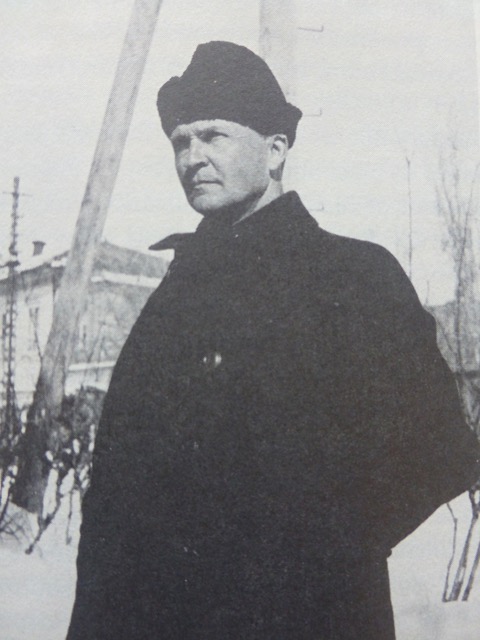
Alexis V. Babine was born into a family of provincial merchants in the small Russian town of Elatma (170 or so miles southeast of Moscow), on 22 March 1866. He studied at the prestigious Institute of History and Philology in St. Petersburg, between 1885 and 1887, and then taught at Okhta Trade School. Following a shooting dare, he accidentally killed his best friend. His parents paid ‘blood money’, while Babine worked his way across the country, eventually to Riga. There, in 1899, he was taken on, as a stoker, by a German ship, which carried him to the United Sates.
Once in the US, Babine studied American history and worked in the library at Cornell University, after which he was appointed a librarian at Indiana University. He moved to Stanford where he was given the post of assistant librarian, and where he taught bibliography and Russian. In 1902, Sabine arrived at the Library of Congress, according to its own website, where he took the position of ‘specialist in charge of the Slavic literature’. He is remembered for negotiating the purchase of a large Russian language collection (from a wealthy Siberian merchant, Genadii Yudin), not only making all the necessary arrangements, transferring 80,000 volumes from Russia to the Library of Congress, but also publishing a bilingual description of the collection, and beginning the work on a catalog for the collection.
In 1910, however, Babine returned to Russia, partly to see his mother who was ill, and partly because he wanted to publish a popular history of the United States in Russian. With that project completed, he worked as an inspector of schools in Kharkov province, and then, after the February revolution, he was appointed to teach English at Saratov university. He may well have died from starvation during the civil war years, but for his participation in the activities of the American Relief Administration (ARA), which supplied its employees with food, as well as with packages from friends in the United States.
Babine went back to the US in 1922, as an émigré, and from 1927 served as the assistant head of the Slavic section of the Library of Congress. He died in 1930. The only further information about Sabine available online appears to be at the Library of Congress website. The Library also holds Babine’s papers, including a very detailed journal he kept in Saratov from 1917 to 1922. This documents the deprivation experienced by the city’s population during the civil war years. The journal has been used by Eugene G. Pivovarov, a visiting scholar, to analyse price changes of basic foodstuffs.
Otherwise, Babine’s journal has been edited by the historian Donald J. Raleigh, and was published in 1988 by Duke University Press as A Russian Civil War Diary - Alexis Sabine in Saratov, 1917-1922. According to Raleigh: ‘Sabine kept his diary in the expectation that it would be published someday. He also wrote it for an American audience. Disgusted with what he called the “backwardness and barbarity” of his native country, Sabine could be a myopic observer. He expressed longing for a return to the old regime that had become politically and morally bankrupt even in the eyes of Saratov’s (and Russia’s) middle class. [. . .] The diary is a unique historical source because it offers readers a rare glimpse into daily life during the Civil War in the provincial city of Saratov. Sabine not only had an unusual story to tell, but also the ability to do so, and his writing casts fresh, if refracted, light on the Russian Civil Ware from an unfamiliar angle.’
Here are several extracts from the published journal.
19 March 1917.
‘I was waiting for my relay horses to rest before taking me to my next school, when an excited traveler suddenly broke into the dirty station room and gleefully announced the new millennium: Nicholas II has abdicated in favor of his brother Michael. A free constitutional rule, perhaps even a republic, is assured. The man’s accent bespoke a Pole. The stationmaster and his peasant help looked at him sourly. One could read in their eyes: “What joy can there be in a tsar’s abdication - except for an infidel like you?” It was now questionable whether I should hurry home by rail and cut short my school inspection program, or disregard the change of rule and carry out my plans as though nothing had happened. I chose the latter course.’
21 March 1917
‘At Nikolsk the liberals - social revolutionaries - are forcing themselves to the fore in matters of local administration. Old government officials are beginning to feel pressure from the oncoming disorderly tide. Teachers feel their positions threatened by anarchist inroads and do not know where to turn. I calmly ignore the new developments and attend to my work in utter disregard of what has happened in St. Petersburg.’
27 March 1917
‘Meetings have been held in the auditorium of the Totma Manual Training School by revolutionary agitators who would not have even dreamed two weeks ago of entering the school premises without proper - i.e., my - sanction. The master of the relay station tells me that German prisoners living in a house nearby claim that the war will soon be over. “And they know everything.” ’
29 March 1917
‘Straggling, worn out, shabbily clad soldiers are beginning to line the road, trudging wearily along, with half empty knapsacks on their backs, homeward bound.’
7 March 1918
‘3:40 p.m. At about 5 p.m. yesterday I saw on the corner of Nemetskaia and Aleksandrov streets a number of Red Guardsmen rather energetically ordering the crowd assembled there to disperse. I had barely time to return home from Tiedeman’s music store when sharp firing was heard from the same corner, and people rushed up Nemetskaia Street. A few minutes later the howl of what sounded like a wounded boy filled the air. From my window I saw two soldiers driving the crowd and brandishing their muskets on the opposite side of the street. But the street was full of people again in a few minutes.
This morning I was told that a number of people had been killed and wounded on Aleksandrov Street. My informant with his own eyes saw a wounded man.
In front of the post office building a young man came up to the crowd assembled there and without any warning shot a man dead. The crowd made a rush at the murderer and killed him on the spot. Mr. Luchinkin told one of our janitors that on his way to the university library this morning he saw on one of the streets the body of a man killed apparently last night, and by ten o’clock this morning not yet removed.’
22 November 1918
‘At the tea table of a socially humble friend’s, with the samovar hospitably whispering and sizzling, I was introduced to a friend of the family, a Soviet official, pale from rheumatism, but good-looking and well built, apparently a mechanic by profession. When the conversation turned to the treatment of the bourgeoisie by the new regime, my new acquaintance spoke firmly in support of a statement of his: “I by no means regret shooting and killing my fourteen men, not in the least.” My friend, giving him a quiet look, explained: “Of course, you only saw to their being executed,” and nicely shifted the conversation to another topic. My friend is a perfectly respectable man, but his company - sumptuously treated considering the times - was a revelation to me.’
24 November 1918
‘Was fortunate enough to get the address of a peasant woman in Monastyrka that sold me 10 lbs. of onions for only forty rubles. It was a three-mile long jubilation to carry them home on my back in a gunnysack, without risk of confiscation, onions being an article the Soviets have forgotten to nationalize.
25 November 1918
‘The Allied powers are said to have presented an ultimatum to the Bolshevik misrulers in Moscow, demanding unconditional surrender. An order is said to have been received here from Moscow to disarm the Red Army. Some local companies have refused to part with their weapons, though willing to surrender.’
26 November 1918
‘Petrograd is said to have been occupied by the Allies - to everybody’s secret joy.’
28 November 1918
‘A sudden search of guests in one of the new socialist cafes produced an unexpected result. One customer had a large amount of small change that is so scarce nowadays; another had a large sum of money in Astrakhan and Samara local currencies.’
15 August 1919
‘A lady friend of mine got three weeks in jail for making her own soap, an article monopolized, but not supplied, by the Soviets and much missed by the people who under the old regime had become accustomed to buying it in the open market in any quantity and at a low price.’
27 August 1919
‘Not wishing to patronize the dirty Soviet barber-shops and out of respect for the typhus raging all around, I have been clipping my hair myself with a 000 clip. It takes over two hours, and two mirrors, to do the work right. Two years ago I would not have thought the trick possible.’
28 August 1919
‘A couple of bachelors have been poisoning cockroaches in their kitchen with arsenic. They threw the dead insects into the yard, upon which their neighbors’ chickens died one after another. “Don’t worry about our being suspected,” quoth the younger of the two: “I’ve already thrown a quiet hint that our Jewish neighbors must have done it.”
5 September 1919
‘A paroled prisoner of war happened to come in quest of milk. My peasant landlord wanted to know what Denikin’s political platform was. The soldier mentioned among other things “the one and indivisible Russia.” “That is right,” said my landlord, with an air of supreme satisfaction stroking his long gray beard: “What’s mine is mine, and I ain’t got to divide it with no riff-raff as they wants it done under this here Communism.”
21 February 1922
‘Robberies of supplies from our trains are so frequent, the transportation so bad, cooperation on the part of the railroad authorities, employees, and the Soviets in general so luke-warm and inefficient, that both Kinne and Cobb feel very much discouraged and want to leave the country as soon as they can. Our town transport agent (a young German-Russian) has been reported as removing, with the connivance and cooperation of the railroad service, supplies from the care of ARA before making out his statements of shortages. He is being watched by Soviet secret service men - who know too well on which side the bread is buttered.’
22 February 1922
‘Someone told me about Professor Stadnitskii’s statement in his lecture this afternoon to the effect that a country doctor had been eaten up by the starving peasants in one of the outlying districts. Dr. Uroda has corrected the statement: it was a feldsher (a trained male nurse) that had been eaten, at Balakovo. He was a big, portly man, and his patients did not want him to go to waste when he died from some cause or other. A medical friend of Dr. Uroda’s has had an occasion to taste human flesh. Lost in a blizzard in the boundless Novouzensk prairies, he and his companion came across some frozen bodies, probably victims of the same blizzard and, to save themselves, they carved up, cooked, and ate part of them. The doctor stated that the worst part of that experience was the insuperable and uncomfortable craving he and his companion had acquired for human flesh.’ [. . .]
‘A medical inspector of ours, driving through a German village, caught glimpse of a couple of little girls running toward the road. He looked back and saw the girls pick up the fresh, warm horse dung and eat it.’
Wednesday, March 16, 2016
An antiphonal chorus
Alasdair Maclean - a Scottish shipyard worker, a poet, a sometime crofter, and eventually a recluse - was born 90 years ago today. He published two books of poems, but his most memorable work is an unusual literary memoir - Night Falls on Ardnamurchan - in which he uses diaries kept by his father as well as his own diaries to, well I suppose, mourn the passing of the crofting way of life. As he explains in the book’s preface, he wants to tell ‘something of the rise and fall of a crofting hamlet in a remote and little-known region of these islands’ through the life and hard times of his father. However, he is aware that a few of his own concerns, not least his literary aspirations, might appear here and there, and concludes: ‘The reader should picture me as an antiphonal chorus to Father and make what allowance he can when I show myself too much the soloist.’

Maclean was born on 16 March 1926 in Glasgow where his father had come after the First World War in search of work. His father, in fact, had been born in the tiny hamlet of Sanna in Ardnamurchan, a wild and remote peninsula in Western Scotland. Maclean left school when only 14, and worked in the Clydesdale shipyards before doing his National Service, in India and Malaya. He lived for 10 years in Canada, and then, on returning to Scotland, studied English at Edinburgh University (from 1966 to 1970). His parents, who had retired to the family croft in Sanna many years previously, both died in 1973.
Although Maclean had written poetry from an early age, he returned to writing poems in his 40s, publishing a first collection From the Wilderness in 1973. Waking the Dead followed in 1976. In 1984, Victor Gollancz published Maclean’s third and final book, the autobiographical work, Night Falls on Ardnamurchan: The Twilight of a Crofting Family, which brought him a modest amount of literary attention. It includes a substantial section from his father’s diaries (never named, and only called ‘Father’ throughout) in 1960 and 1970, with a commentary by Maclean, as well as a series of Maclean’s own diary entries from the time when he was living in Sanna and working on the book (1979-1980).
Subsequently, Maclean lived an increasingly isolated life at his Fife cottage, journeying less and less often to the Sanna croft. He died in 1994. There is very little further information about Maclean readily available online, but Wikipedia has a short entry, and The Herald has an obituary.
Here are a few paragraphs from Maclean’s preface to Night Falls on Ardnamurchan: ‘I can at least inform the reader that my book is built around extracts from two journals, my father’s and my own, both set (mostly) in the same small village but featuring rather different ways of life and having very different aims and methods. About the circumstances in which each journal was kept and about the plan followed in using it I shall have more to say later. Father was a working crofter, if that is not too much like saying of someone that he was a fare-collecting bus conductor, and his portion of the book constitutes a factual and totally unadorned account of his daily round, an aide memoire for his own benefit as much as anything. His record of crofting life forms the backbone of the book.
Following the extracts from his journal I have included selections from my own daily notes. These sometimes gloss Father in a more extended and looser way, a more indirect way, than the immediate glosses I have given him. Sometimes, too, they reflect on his life and work and sometimes diverge totally into my own concerns. To the extent that I was a crofter it was intermittently and never considering it my chief of occupations. I was a part-time assistant to my father and, briefly after he died, a later and lesser follower. Mainly I thought myself a writer, a poet, and the records I kept necessarily suggested my quite different business. I have tried to prevent the more strictly literary part of my life and thought from overwhelming the rest of my material, reckoning a tale of poetry and its production too narrow a specialization in this day and age for the general reader. But that aspect of things was naturally insistent for me and I have let it intrude on a number of occasions. Were I to present any other picture of myself I should be guilty of serious falsification.
What matters is that there should emerge from these pages something of the rise and fall of a crofting hamlet in a remote and little-known region of these islands, and that this should be displayed through an account of the life and hard times of my father, who was the last man to practise the art of crofting in that hamlet. If, parallel with this account and rounding it off, there should also appear a little of myself, who watched that life and that death and who, perhaps, survived it, I trust the reader will not think it too great an imposition. My literary work, indeed, grows out of that background, or did so when I kept my Ardnamurchan journal, and even where I may appear to depart most radically from the matter in hand a link of some kind could generally be found, for all that it might take a course in psychoanalysis to trace its windings. The reader should picture me as an antiphonal chorus to Father and make what allowance he can when I show myself too much the soloist.’
And here are several extracts from Maclean’s diary.
8 October 1979
‘It is two o’clock in the morning and I feel very tired. But a point of terminology nags at me and I may not rest till I have said something about it.
I have been describing this record of mine, I notice, as a journal, not a diary. What is the difference?
I think that a diary functions at a lower level. It represents - or is thought to represent - a lesser species of literature. It is more gossipy and slapdash, more concerned with jottings, more practical, less obviously intended for other eyes. So we speak of Pepys’ Diaries but of Dorothy Wordsworth’s Journals and mean, I believe, to denigrate Pepys a little when we make the distinction. Yet who would exchange the former for the latter? Not I, at any rate, though I am fond of both.
I suspect that nowadays at least, there is an element of snobbishness involved in the journal-diary antithesis. Schoolgirls, archetypally, keep diaries; poets, therefore, must write journals. (It is true that Yeats wrote a diary but true also that he took the precaution of dignifying it with a fairly resounding tide: ‘Estrangment’ [sic].)
My father, old seaman, was unbothered by such nuances and called his daily notes a ‘log’. I shall stick to journal.
5 December 1979
I came today to a corner on the seaward edge of the dunes where a mummified thistle, one of last summer’s crop, still held its form against rain and gale. It was not a Carline Thistle, so attractive and about here so rare. These commonly survive as husks sometimes well into the next season. This fellow was an ordinary Spear Thistle, brown and shrunken, like an old man dead in all but will. It might have been nature’s master copy, struggling to preserve the idea of a thistle for the next generation of plants. Two or three of its heads lolled brokenly in the wind, yet its spikes stuck out more prominently than ever from its withered leaves. I thought of a cornered dog, retracting its gums the better to show its teeth. How admirable it was, how puritanically beautiful! I stood beside it for a long time, studying it and trying to fix it in my mind.’
10 January 1980
‘How trusting-hungry are the small birds now! When I scattered crumbs at the garden gate this afternoon (later than usual for it was dusk and town-bred birds would have been well-filled to bed an hour before), a dozen of sparrows hung precariously in the gusts, a bare yard or two from my hand. Though the gale thrust them constantly downwind, away from the source of food, still they persisted, flapping like little machines in an effort to keep pace with their own lives. At times they took the whirling nourishment on the wing.
I wonder now, sitting over my late journal, in what corner of this many-cornered village do these birds roost? Surely there is no hiding-place here that can so well hug its angles to itself but that the wind pokes a long cold finger in? Yet somewhere they crouch, fluffed out and twittering, and their thin blood slowly crystallizes as the stars wheel overhead.
Not all survive such nights. You find them here and there in the mornings, on their backs, their claws tenaciously gripping air. Even when they live who can tell what transformations may not haunt them as they perch the dark away? When a night like this comes along I think it is a little hibernation that sees these sparrows through. Ghost birds I think they become, for the space of a few hours; approximate creatures. Yet when day appears, or even the appalling masquerade that may substitute for it at this time of year, out from bush or cave they tumble, like toy trumpets from a lucky dip.’
26 March 1980
‘I am now well into 1970 with my editing task. Another month, at most, should see me finished. As well, too, for I grow very short of money. I must look to the future now. I must consider what may happen when the last shilling goes and I have to leave here.
If I were sure of being able to support myself with my pen I should not care so much. But freelance writing is such a precarious and at times degrading way of earning a living. Constantly a buttering up of editors, constantly a hinting at commissions. And constantly, too, looking out for the postman, with his good news or his bad news and constantly waiting for a cheque that may or may not be coming or may be coming when someone in an office somewhere gets around to sending it.
I have had my share of all that in the past and am none too keen on going through it again. It is hardly even that the freelance is doing what he wants to do or is doing something at least closely related to his vocation. Very often he isn’t.
Yet a small voice inside me says, ‘Still it is better than working.’ Perhaps so. I have had my share, too, of soul-destroying jobs and know what they can do to one. Nevertheless I have taken the precaution of pulling the one or two gossamery strings I yet hold, to see if I cannot arrange for employment of some kind in Kirkcaldy, where I lived before and where I know people. I should get on faster if I were better able to transfer my written notes to typescript. The typewriter is a hateful machine. I had rather have the toothache than change a ribbon. And I have coined a new definition of Sod’s Law: ‘When two typewriter keys are struck at once the one that gets to the paper first is never the one that is wanted.’
The Diary Junction

Maclean was born on 16 March 1926 in Glasgow where his father had come after the First World War in search of work. His father, in fact, had been born in the tiny hamlet of Sanna in Ardnamurchan, a wild and remote peninsula in Western Scotland. Maclean left school when only 14, and worked in the Clydesdale shipyards before doing his National Service, in India and Malaya. He lived for 10 years in Canada, and then, on returning to Scotland, studied English at Edinburgh University (from 1966 to 1970). His parents, who had retired to the family croft in Sanna many years previously, both died in 1973.
Although Maclean had written poetry from an early age, he returned to writing poems in his 40s, publishing a first collection From the Wilderness in 1973. Waking the Dead followed in 1976. In 1984, Victor Gollancz published Maclean’s third and final book, the autobiographical work, Night Falls on Ardnamurchan: The Twilight of a Crofting Family, which brought him a modest amount of literary attention. It includes a substantial section from his father’s diaries (never named, and only called ‘Father’ throughout) in 1960 and 1970, with a commentary by Maclean, as well as a series of Maclean’s own diary entries from the time when he was living in Sanna and working on the book (1979-1980).
Subsequently, Maclean lived an increasingly isolated life at his Fife cottage, journeying less and less often to the Sanna croft. He died in 1994. There is very little further information about Maclean readily available online, but Wikipedia has a short entry, and The Herald has an obituary.
Here are a few paragraphs from Maclean’s preface to Night Falls on Ardnamurchan: ‘I can at least inform the reader that my book is built around extracts from two journals, my father’s and my own, both set (mostly) in the same small village but featuring rather different ways of life and having very different aims and methods. About the circumstances in which each journal was kept and about the plan followed in using it I shall have more to say later. Father was a working crofter, if that is not too much like saying of someone that he was a fare-collecting bus conductor, and his portion of the book constitutes a factual and totally unadorned account of his daily round, an aide memoire for his own benefit as much as anything. His record of crofting life forms the backbone of the book.
Following the extracts from his journal I have included selections from my own daily notes. These sometimes gloss Father in a more extended and looser way, a more indirect way, than the immediate glosses I have given him. Sometimes, too, they reflect on his life and work and sometimes diverge totally into my own concerns. To the extent that I was a crofter it was intermittently and never considering it my chief of occupations. I was a part-time assistant to my father and, briefly after he died, a later and lesser follower. Mainly I thought myself a writer, a poet, and the records I kept necessarily suggested my quite different business. I have tried to prevent the more strictly literary part of my life and thought from overwhelming the rest of my material, reckoning a tale of poetry and its production too narrow a specialization in this day and age for the general reader. But that aspect of things was naturally insistent for me and I have let it intrude on a number of occasions. Were I to present any other picture of myself I should be guilty of serious falsification.
What matters is that there should emerge from these pages something of the rise and fall of a crofting hamlet in a remote and little-known region of these islands, and that this should be displayed through an account of the life and hard times of my father, who was the last man to practise the art of crofting in that hamlet. If, parallel with this account and rounding it off, there should also appear a little of myself, who watched that life and that death and who, perhaps, survived it, I trust the reader will not think it too great an imposition. My literary work, indeed, grows out of that background, or did so when I kept my Ardnamurchan journal, and even where I may appear to depart most radically from the matter in hand a link of some kind could generally be found, for all that it might take a course in psychoanalysis to trace its windings. The reader should picture me as an antiphonal chorus to Father and make what allowance he can when I show myself too much the soloist.’
And here are several extracts from Maclean’s diary.
8 October 1979
‘It is two o’clock in the morning and I feel very tired. But a point of terminology nags at me and I may not rest till I have said something about it.
I have been describing this record of mine, I notice, as a journal, not a diary. What is the difference?
I think that a diary functions at a lower level. It represents - or is thought to represent - a lesser species of literature. It is more gossipy and slapdash, more concerned with jottings, more practical, less obviously intended for other eyes. So we speak of Pepys’ Diaries but of Dorothy Wordsworth’s Journals and mean, I believe, to denigrate Pepys a little when we make the distinction. Yet who would exchange the former for the latter? Not I, at any rate, though I am fond of both.
I suspect that nowadays at least, there is an element of snobbishness involved in the journal-diary antithesis. Schoolgirls, archetypally, keep diaries; poets, therefore, must write journals. (It is true that Yeats wrote a diary but true also that he took the precaution of dignifying it with a fairly resounding tide: ‘Estrangment’ [sic].)
My father, old seaman, was unbothered by such nuances and called his daily notes a ‘log’. I shall stick to journal.
5 December 1979
I came today to a corner on the seaward edge of the dunes where a mummified thistle, one of last summer’s crop, still held its form against rain and gale. It was not a Carline Thistle, so attractive and about here so rare. These commonly survive as husks sometimes well into the next season. This fellow was an ordinary Spear Thistle, brown and shrunken, like an old man dead in all but will. It might have been nature’s master copy, struggling to preserve the idea of a thistle for the next generation of plants. Two or three of its heads lolled brokenly in the wind, yet its spikes stuck out more prominently than ever from its withered leaves. I thought of a cornered dog, retracting its gums the better to show its teeth. How admirable it was, how puritanically beautiful! I stood beside it for a long time, studying it and trying to fix it in my mind.’
10 January 1980
‘How trusting-hungry are the small birds now! When I scattered crumbs at the garden gate this afternoon (later than usual for it was dusk and town-bred birds would have been well-filled to bed an hour before), a dozen of sparrows hung precariously in the gusts, a bare yard or two from my hand. Though the gale thrust them constantly downwind, away from the source of food, still they persisted, flapping like little machines in an effort to keep pace with their own lives. At times they took the whirling nourishment on the wing.
I wonder now, sitting over my late journal, in what corner of this many-cornered village do these birds roost? Surely there is no hiding-place here that can so well hug its angles to itself but that the wind pokes a long cold finger in? Yet somewhere they crouch, fluffed out and twittering, and their thin blood slowly crystallizes as the stars wheel overhead.
Not all survive such nights. You find them here and there in the mornings, on their backs, their claws tenaciously gripping air. Even when they live who can tell what transformations may not haunt them as they perch the dark away? When a night like this comes along I think it is a little hibernation that sees these sparrows through. Ghost birds I think they become, for the space of a few hours; approximate creatures. Yet when day appears, or even the appalling masquerade that may substitute for it at this time of year, out from bush or cave they tumble, like toy trumpets from a lucky dip.’
26 March 1980
‘I am now well into 1970 with my editing task. Another month, at most, should see me finished. As well, too, for I grow very short of money. I must look to the future now. I must consider what may happen when the last shilling goes and I have to leave here.
If I were sure of being able to support myself with my pen I should not care so much. But freelance writing is such a precarious and at times degrading way of earning a living. Constantly a buttering up of editors, constantly a hinting at commissions. And constantly, too, looking out for the postman, with his good news or his bad news and constantly waiting for a cheque that may or may not be coming or may be coming when someone in an office somewhere gets around to sending it.
I have had my share of all that in the past and am none too keen on going through it again. It is hardly even that the freelance is doing what he wants to do or is doing something at least closely related to his vocation. Very often he isn’t.
Yet a small voice inside me says, ‘Still it is better than working.’ Perhaps so. I have had my share, too, of soul-destroying jobs and know what they can do to one. Nevertheless I have taken the precaution of pulling the one or two gossamery strings I yet hold, to see if I cannot arrange for employment of some kind in Kirkcaldy, where I lived before and where I know people. I should get on faster if I were better able to transfer my written notes to typescript. The typewriter is a hateful machine. I had rather have the toothache than change a ribbon. And I have coined a new definition of Sod’s Law: ‘When two typewriter keys are struck at once the one that gets to the paper first is never the one that is wanted.’
The Diary Junction
The longest whisper ever
‘My words can give no suggestion of the self-transcendence invoked, and I fear, too, that any music I eventually write can only give the palest hint. One of the most serendipitous moments came when a snow avalanche poured and billowed down the mountain directly to starboard - imagine the mightiest, gentlest, longest whisper ever - we were enveloped for a space in mad, dancing flakes, a white-out - a moment that will last a lifetime.’ This is from the diary of Sir Peter Maxwell Davies - who has just died - on a visit to the Antarctic, some 20 years ago, a journey which provided the inspiration for his Antarctic Symphony (Symphony No. 8).

Peter Maxwell Davies (most commonly known as Max) was born in 1934, in Salford, Lancashire. He had piano lessons and began composing from an early age, submitting a composition called Blue Ice to the BBC when only 14. The BBC producer Trevor Hill nurtured Davies young talent, introducing him to professional musicians. After attending Leigh Boys Grammar School, he studied at the University of Manchester and at the Royal Manchester College of Music. With fellow students, including Harrison Birtwistle, he formed New Music Manchester, a group committed to contemporary music. He studied for a year under Goffredo Petrassi in Rome thanks to an Italian government scholarship, and, in 1959, became director of music at Cirencester Grammar School.
In 1962, Davies won a Harkness Fellowship for Princeton University (with the help of Aaron Copland and Benjamin Britten), after which he was composer-in-residence at the Elder Conservatorium of Music, University of Adelaide. In 1966, he returned to the UK and went to live in the Orkney Islands, initially to Hoy and later to Sanday. In 1977, he was part of a group that founded the midsummer St Magnus Festival held on the islands. He was artistic director of the Dartington International Summer School from 1979 to 1984, and from 1992 to 2002 he was associate conductor/composer with the Royal Philharmonic Orchestra, a position he also held with the BBC Philharmonic Orchestra. He conducted a number of other prominent orchestras, and was also Composer Laureate of the Scottish Chamber Orchestra.
Davies published over 200 musical works during his lifetime, including 10 symphonies and 17 concertos, operas (such as Taverner, The Martyrdom of St Magnus and The Doctor of Myddfai), and the full-length ballet Salome. One of his most popular shorter works, An Orkney Wedding with Sunrise, was written on commission for the Boston Pops Orchestra. He also wrote many works for performance by children, premiering them at the St Magnus Festival. Other notable compositions include Antarctic Symphony (Symphony No. 8), jointly commissioned by the Philharmonia Orchestra and the British Antarctic Survey, Mr Emmet Takes a Walk, and Sea Orpheus.
Davies was openly homosexual, though had a messy, and all-to-public separation from his long-term partner in 2012. He was often at odds with the establishment, whether politically or musically, though time found him embracing, and being embraced by, this very same establishment. Once considered a kind of enfant terrible, producing overly avant-garde music, he became one of the world’s most respected composers, being knighted in 1987, and, in 2004, being appointed Master of the Queen’s Music. Davies, for his part, abandoned his youthful republicanism, turning latterly to support the idea of monarchy. Davies died on 14 March. Further information can be found online via the official Peter Maxwell Davies (MaxOpus) website, Wikipedia, Boosey & Hawkes, inter.musica, Schott Music or many obituaries (The Guardian, for example, The Telegraph, The New York Times, and The Scotsman).
Before writing the Antarctic Symphony, Davies was invited by the British Antarctic Survey (BAS) to join its supply and research vessel RRS James Clark Ross on a visit to the region, and, in particular, BAS Rather station. Davies kept a detailed diary on the journey, which was later published in a limited edition of 1,500 as Notes from a cold climate : Antarctic Symphony (Symphony No. 8). The diary text can be found on the MaxOpus website, which is the source of the following extracts.
21 December 1997
‘A procession of icebergs, mysterious and deeply awe-inspiring. Of course it is we who are moving faster, but in calmer waters one has the illusion of a stately mannequin parade, as the model’s outlines modulate, revealing new and secret shapes and colours. Contours suddenly glow with an irridescent blue of an unimaginable intensity: this is the best exhibition of abstract sculpture I ever saw. All that one has read of fractals and the Mandelbrot set floods the brain, perhaps as some kind of bulwark against the wonder, which I quietly admit is overwhelming, even transcendental. Some icebergs pick up and maintain the upward surge of wave motion: some repeat and develop the forms of clouds: others, seen against a backdrop of snow-covered cliffs and hills, take up the forms and energies characteristic of these, while the best combine all of these features with a capricious dynamism that constantly modifies and transforms as we pass. A whale, travelling at a furious fifteen knots, faster than the ship, briefly surfaces, its back confirming a neighbouring iceberg’s. Another iceberg suddenly appears as a gigantic swan. Another reveals a Norman arch, fifty foot high, with ice packed above this for another hundred feet - a broken-off fragment of a medieval abbey.
Sometimes I find mealtime conversation quite baffling - top scientists talk shop, their jargon bristling with acronyms. They are very patient when I enquire about their particular speciality and any possible future practical application.’
22 December 1997
‘The engines stop, and 33 scientists, Judy and I file down a rope ladder into a launch already bulging with boxes, barrels, crates. We are delivering supplies to the tiny station of Port Lockroy, and dropping off Dave Burkitt and Rod Downie who will man the place, alone for three months. It was established in 1944, and abandoned in 1962. In 1996 it was restored by the U.K. Antarctic Heritage Trust, and now boasts a small museum and post office, to open in summer for visits by cruise ships and private yachts.
The pack ice has broken up enough for us to land without problems - a very small, rocky island, with gentoo penguins nesting everywhere, so that you must take great care not to disturb them, right away upon beaching. The smell of penguin guana crinkles your nose - all pervasive bad fish. Everybody carries the cargo into the store-shed or up to the house: each case is clearly marked, and checked on a tally by Dave, who semaphores the operations. The privilege of raising the British flag to the top of its mast, at the highest point by the house, falls to Linda, on behalf of BAS, and me. Such an unaccustomed honour makes me very nervous, as I fumble with intransigent ropes, tugging ineffectively and desperately. A great relief when the flag ascends and unfurls.
A magical spot, an island surrounded by mainland cliffs, monumental white mountains. The all-pervasive sound is of broken packice lifting on and off the shore rocks - a Gargantuan cocktail shaker. Add to that the gentle buzz of conversation among the ubiquitous penguins, with the occasional raised squawk as a sheathbill - a small grubby white seabird - lunges towards a penguin egg - and that’s the island's sound spectrum.
The mainland is only 100 yards away from one point, but safety regulations determine that the keepers are not allowed to have a boat. Their accommodation is sparse but solid - there is plenty of coal still from the forties - and the museum has relics evocative of that time - ancient cans of food, oatmeal packets, tools in situ, all with excellent explanatory displays.
Once we have determined that the radio link to the main station at Rothera is operative, we pile back into the launch and return to the RRS James Clark Ross. This was the first time I had worn any of the Antarctic gear issued by BAS - it was surrealistic being kitted out at headquarters in Cambridge last July, pulling on the layer after layer of thermals and waterproofs on one of the hottest days ever - but here we would not survive without these. It is a great relief to take them off for lunch - particularly the huge guana-smeared boots. There are strict dress codes for meals on board, to be transgressed at one’s peril.
This afternoon we glide through the Lemaire Strait - a narrow passage between the almost vertical sides of mountains jutting thousands of feet up into cloud. Apart from the gentle hum of the boat’s engines - the JCR is extremely quiet, to facilitate very precise sonar experiments - the silence is profound. There is hardly any talk, either on the bridge or on deck - everyone is so over-awed by the grandeur, the power of the unfolding spectacle. My words can give no suggestion of the self-transendence invoked, and I fear, too, that any music I eventually write can only give the palest hint. One of the most serendipitous moments came when a snow avalanche poured and billowed down the mountain directly to starboard - imagine the mightiest, gentlest, longest whisper ever - we were enveloped for a space in mad, dancing flakes, a white-out - a moment that will last a lifetime.
Shortly after 4 p.m. a small party descended a very long rope ladder into a very small launch, to take Christmas mail to Vernadsky, the Ukranian Antarctic Expedition base. This base was formerly British, named Faraday after Michael Faraday, the Physicist and was handed over to the Ukrainians in 1995. John Harper, the mate of the JCR, was in charge, standing tall at the stem, shouting instructions and semaphoring to the wheel-house, to ensure a safe passage through the ice-flows. Even the unfrozen sea-water was like oil, thickly viscous. A gaggle of long huts on a small rise, where we tie up, welcomed enthusiastically, and are helped through deep snow to the Christmassy domestic warmth of the settlement. Such a joyful, beautiful welcome from the dozen or so men and women - we take off our boots and layers of gear, and troop up to the bar. This is the biggest and most famous bar in the Antarctic - a riot of decorative carving, made by over-enthusiastic British joiners, who, for the waste of time and wood, were promptly sent home.
Delighted hosts and guests, excellent black coffee of the kind that dissolves the spoon and scalds your tonsils, chocolate, generous globes of Ukrainian cognac. A welcoming speech from Vladimir Okrugin, the head of the team, and we are shown round the base by Svetlana, a meteorologist, climbing champion, guitarist and computer expert. Many things - equipment, notices, photographs - have been left as they were when the British ran the station. Up a ladder into a loft office, where we met Daphne, a Dobson spectrophotometer, the piece of scientific equipment, from 1957, which was the means of discovering the hole in the ozone layer. A speech by Julian Paren, generous vodka all round, stirring Ukranian music, and we are bobbing our way through corridors of ice back to the RRS James Clark Ross. A huddle of figures waving on the jetty: one wonders when anyone will visit them next. Pete Bucktrout, our official photographer, asks why all international and diplomatic relations can’t be like this. Why indeed?! I sport the badge of the Ukranian Antarctic Expedition, and clutch a book about their homeland.’

Peter Maxwell Davies (most commonly known as Max) was born in 1934, in Salford, Lancashire. He had piano lessons and began composing from an early age, submitting a composition called Blue Ice to the BBC when only 14. The BBC producer Trevor Hill nurtured Davies young talent, introducing him to professional musicians. After attending Leigh Boys Grammar School, he studied at the University of Manchester and at the Royal Manchester College of Music. With fellow students, including Harrison Birtwistle, he formed New Music Manchester, a group committed to contemporary music. He studied for a year under Goffredo Petrassi in Rome thanks to an Italian government scholarship, and, in 1959, became director of music at Cirencester Grammar School.
In 1962, Davies won a Harkness Fellowship for Princeton University (with the help of Aaron Copland and Benjamin Britten), after which he was composer-in-residence at the Elder Conservatorium of Music, University of Adelaide. In 1966, he returned to the UK and went to live in the Orkney Islands, initially to Hoy and later to Sanday. In 1977, he was part of a group that founded the midsummer St Magnus Festival held on the islands. He was artistic director of the Dartington International Summer School from 1979 to 1984, and from 1992 to 2002 he was associate conductor/composer with the Royal Philharmonic Orchestra, a position he also held with the BBC Philharmonic Orchestra. He conducted a number of other prominent orchestras, and was also Composer Laureate of the Scottish Chamber Orchestra.
Davies published over 200 musical works during his lifetime, including 10 symphonies and 17 concertos, operas (such as Taverner, The Martyrdom of St Magnus and The Doctor of Myddfai), and the full-length ballet Salome. One of his most popular shorter works, An Orkney Wedding with Sunrise, was written on commission for the Boston Pops Orchestra. He also wrote many works for performance by children, premiering them at the St Magnus Festival. Other notable compositions include Antarctic Symphony (Symphony No. 8), jointly commissioned by the Philharmonia Orchestra and the British Antarctic Survey, Mr Emmet Takes a Walk, and Sea Orpheus.
Davies was openly homosexual, though had a messy, and all-to-public separation from his long-term partner in 2012. He was often at odds with the establishment, whether politically or musically, though time found him embracing, and being embraced by, this very same establishment. Once considered a kind of enfant terrible, producing overly avant-garde music, he became one of the world’s most respected composers, being knighted in 1987, and, in 2004, being appointed Master of the Queen’s Music. Davies, for his part, abandoned his youthful republicanism, turning latterly to support the idea of monarchy. Davies died on 14 March. Further information can be found online via the official Peter Maxwell Davies (MaxOpus) website, Wikipedia, Boosey & Hawkes, inter.musica, Schott Music or many obituaries (The Guardian, for example, The Telegraph, The New York Times, and The Scotsman).
Before writing the Antarctic Symphony, Davies was invited by the British Antarctic Survey (BAS) to join its supply and research vessel RRS James Clark Ross on a visit to the region, and, in particular, BAS Rather station. Davies kept a detailed diary on the journey, which was later published in a limited edition of 1,500 as Notes from a cold climate : Antarctic Symphony (Symphony No. 8). The diary text can be found on the MaxOpus website, which is the source of the following extracts.
21 December 1997
‘A procession of icebergs, mysterious and deeply awe-inspiring. Of course it is we who are moving faster, but in calmer waters one has the illusion of a stately mannequin parade, as the model’s outlines modulate, revealing new and secret shapes and colours. Contours suddenly glow with an irridescent blue of an unimaginable intensity: this is the best exhibition of abstract sculpture I ever saw. All that one has read of fractals and the Mandelbrot set floods the brain, perhaps as some kind of bulwark against the wonder, which I quietly admit is overwhelming, even transcendental. Some icebergs pick up and maintain the upward surge of wave motion: some repeat and develop the forms of clouds: others, seen against a backdrop of snow-covered cliffs and hills, take up the forms and energies characteristic of these, while the best combine all of these features with a capricious dynamism that constantly modifies and transforms as we pass. A whale, travelling at a furious fifteen knots, faster than the ship, briefly surfaces, its back confirming a neighbouring iceberg’s. Another iceberg suddenly appears as a gigantic swan. Another reveals a Norman arch, fifty foot high, with ice packed above this for another hundred feet - a broken-off fragment of a medieval abbey.
Sometimes I find mealtime conversation quite baffling - top scientists talk shop, their jargon bristling with acronyms. They are very patient when I enquire about their particular speciality and any possible future practical application.’
22 December 1997
‘The engines stop, and 33 scientists, Judy and I file down a rope ladder into a launch already bulging with boxes, barrels, crates. We are delivering supplies to the tiny station of Port Lockroy, and dropping off Dave Burkitt and Rod Downie who will man the place, alone for three months. It was established in 1944, and abandoned in 1962. In 1996 it was restored by the U.K. Antarctic Heritage Trust, and now boasts a small museum and post office, to open in summer for visits by cruise ships and private yachts.
The pack ice has broken up enough for us to land without problems - a very small, rocky island, with gentoo penguins nesting everywhere, so that you must take great care not to disturb them, right away upon beaching. The smell of penguin guana crinkles your nose - all pervasive bad fish. Everybody carries the cargo into the store-shed or up to the house: each case is clearly marked, and checked on a tally by Dave, who semaphores the operations. The privilege of raising the British flag to the top of its mast, at the highest point by the house, falls to Linda, on behalf of BAS, and me. Such an unaccustomed honour makes me very nervous, as I fumble with intransigent ropes, tugging ineffectively and desperately. A great relief when the flag ascends and unfurls.
A magical spot, an island surrounded by mainland cliffs, monumental white mountains. The all-pervasive sound is of broken packice lifting on and off the shore rocks - a Gargantuan cocktail shaker. Add to that the gentle buzz of conversation among the ubiquitous penguins, with the occasional raised squawk as a sheathbill - a small grubby white seabird - lunges towards a penguin egg - and that’s the island's sound spectrum.
The mainland is only 100 yards away from one point, but safety regulations determine that the keepers are not allowed to have a boat. Their accommodation is sparse but solid - there is plenty of coal still from the forties - and the museum has relics evocative of that time - ancient cans of food, oatmeal packets, tools in situ, all with excellent explanatory displays.
Once we have determined that the radio link to the main station at Rothera is operative, we pile back into the launch and return to the RRS James Clark Ross. This was the first time I had worn any of the Antarctic gear issued by BAS - it was surrealistic being kitted out at headquarters in Cambridge last July, pulling on the layer after layer of thermals and waterproofs on one of the hottest days ever - but here we would not survive without these. It is a great relief to take them off for lunch - particularly the huge guana-smeared boots. There are strict dress codes for meals on board, to be transgressed at one’s peril.
This afternoon we glide through the Lemaire Strait - a narrow passage between the almost vertical sides of mountains jutting thousands of feet up into cloud. Apart from the gentle hum of the boat’s engines - the JCR is extremely quiet, to facilitate very precise sonar experiments - the silence is profound. There is hardly any talk, either on the bridge or on deck - everyone is so over-awed by the grandeur, the power of the unfolding spectacle. My words can give no suggestion of the self-transendence invoked, and I fear, too, that any music I eventually write can only give the palest hint. One of the most serendipitous moments came when a snow avalanche poured and billowed down the mountain directly to starboard - imagine the mightiest, gentlest, longest whisper ever - we were enveloped for a space in mad, dancing flakes, a white-out - a moment that will last a lifetime.
Shortly after 4 p.m. a small party descended a very long rope ladder into a very small launch, to take Christmas mail to Vernadsky, the Ukranian Antarctic Expedition base. This base was formerly British, named Faraday after Michael Faraday, the Physicist and was handed over to the Ukrainians in 1995. John Harper, the mate of the JCR, was in charge, standing tall at the stem, shouting instructions and semaphoring to the wheel-house, to ensure a safe passage through the ice-flows. Even the unfrozen sea-water was like oil, thickly viscous. A gaggle of long huts on a small rise, where we tie up, welcomed enthusiastically, and are helped through deep snow to the Christmassy domestic warmth of the settlement. Such a joyful, beautiful welcome from the dozen or so men and women - we take off our boots and layers of gear, and troop up to the bar. This is the biggest and most famous bar in the Antarctic - a riot of decorative carving, made by over-enthusiastic British joiners, who, for the waste of time and wood, were promptly sent home.
Delighted hosts and guests, excellent black coffee of the kind that dissolves the spoon and scalds your tonsils, chocolate, generous globes of Ukrainian cognac. A welcoming speech from Vladimir Okrugin, the head of the team, and we are shown round the base by Svetlana, a meteorologist, climbing champion, guitarist and computer expert. Many things - equipment, notices, photographs - have been left as they were when the British ran the station. Up a ladder into a loft office, where we met Daphne, a Dobson spectrophotometer, the piece of scientific equipment, from 1957, which was the means of discovering the hole in the ozone layer. A speech by Julian Paren, generous vodka all round, stirring Ukranian music, and we are bobbing our way through corridors of ice back to the RRS James Clark Ross. A huddle of figures waving on the jetty: one wonders when anyone will visit them next. Pete Bucktrout, our official photographer, asks why all international and diplomatic relations can’t be like this. Why indeed?! I sport the badge of the Ukranian Antarctic Expedition, and clutch a book about their homeland.’
Saturday, March 12, 2016
Damascus diaries
It’s four years since Britain, and many other countries, closed their embassies in Damascus, Syria, and withdrew their diplomatic staff, the famous city having become too dangerous to live in or to visit. Before then, though, it had an exotic appeal to Westerners, especially Peter Clark, who fell in love with the place in the 1960s and then returned in the 1990s to run the British Council branch there. His diaries of that time have just been published by the specialist Middle East publisher, Gilgamesh. They paint, Gilgamesh says, ‘a vivid and almost nostalgic picture of life in this remarkable city’. I, too, have visited Damascus, in the mid-1970s, staying just a couple of days as I hitchhiked my way from Europe to Australia. As my own diary entries remind me, I found the Syrians most friendly and hospitable.

Peter Clark was schooled in Loughborough and Southend before studying at Keele, Cambridge and Leicester universities. He joined the British Council in 1967, mostly working abroad, in the Middle East and Africa, remaining with the institution for 30 years or so. In 1992, he was invited to reopen the British Council office in Syria, a country he’d first visited in 1962, and he remained until 1997. He enjoyed good relations with the British diplomatic staff, and, briefly, met successive foreign ministers, Douglas Hurd and Malcolm Rifkind, on their official visits to Damascus. Among Clark’s cultural successes were a production of Purcell’s opera Dido and Aeneas in Arabic and an exhibition of Freya Stark’s Syria photographs. After retiring from the Council, he returned to Syria occasionally leading lead tour groups.
Clark is fluent in Arabic, and has translated novels, drama, poetry and history by contemporary Arab writers. He has written books on the Islamic scholar Marmaduke Pickthall and the explorer Wilfred Thesiger, and published a collection of writings on the Middle East - Coffeehouse Footnotes - as well as a book on Istanbul. He is a trustee of the International Prize for Arabic Fiction, a contributing editor of Banipal, and an adviser on cultural tourism to Turkey and Syria. He is married, and lives in Frome Somerset. A little further biographical information is available from Debretts, The International Prize for Arabic Fiction, the Gilmour Print Service or a Marmaduke Pickthall fansite.
Throughout most of his adult life, Clark has kept personal diaries, and his time in Damascus was no exception. Perhaps because of the troubles now afflicting Syria and its capital, Gilgamesh - a specialist in Middle East books - has chosen to publish Clark’s diaries of his Damascus years. It says of the book - Damascus Diaries: Life Under the Assads - ‘Here we see the dramas and routines of everyday life played out against the backdrop of the world’s oldest continually inhabited city on the eve of collapse into civil war. Enchanting and alarming by turns, everyday events combine to paint a vivid and almost nostalgic picture of life in this remarkable city.’ Reviews can be read online at The Economist and The Tanjara. Here are several extracts (with thanks to Gilgamesh Publushing).

23 October 1993
‘I am at the office early and at precisely 9.30 we hear the screaming of sirens, and Douglas Hurd, his detective, and the Ambassador arrive, followed by members of his entourage - Richard Culshaw in charge of the press and his Principal Private Secretary, John Sawers, whom I last saw in Yemen in 1980. I take Douglas Hurd round the exhibition of Freya Stark’s photographs, and he talks to some of the staff. He also signs my copy of his novel, The Palace of Enchantments, which was already signed by the co-author, Stephen Lamport, in Abu Dhabi. And that is that. The party disappears and so do we.
Douglas Hurd has called on the President, with Andrew Green. It is the first time Andrew has met him.’
24 October 1993
‘I am in the office very early. The Hurd visit has been seen as a success. A tide is moving in our favour, an enhancement of Syria-British relations. Meanwhile the situation in Algeria gets grimmer by the day. The country is slipping into confusion and foreigners are being kidnapped and assassinated. At this rate the British Council will withdraw and there may be extra funds for Syria. Every cloud has a silver lining.’
20 January 1994
‘In the afternoon we go for a walk, due north, beyond Muhajirin and up the mountain. Jabal Kasiyun has slowly had the city encroaching upon it. We climb up roads that are at a gradient of about 1 in 3. The views over the city get more and more splendid - skyscrapers stand out, tall white buildings, with here and there to the west patches of green, all that is left of the gardens of Damascus. It is invigorating. We descend, passing by an office that is surrounded by dozens of black Mercedes cars and lots of security people. I learn later that this is where the President has his office. It is a shabby building but one can, at least, walk within 20 yards of it, and the residential flats nearby in these leafy suburbs must be desirable.
We are invited to dinner with Dr and Mrs Drubi. He is a prosperous doctor from Homs. She has three daughters, one of whom is studying English at the British Council. Another was Miss Syria in 1986 and is now in Canada. I talk to Zelfa Samman, half-sister of and 20 years younger than the novelist, Ghada, who chooses to live in Paris. Zelfa’s mother is a Shishakli, a niece of the former President, Adib. Her mother’s mother is a sister of Akram Hourani, who is still alive, in exile in Amman, over 80 and frail. Zelfa’s father was President of the University of Damascus and has been briefly Minister of Higher Education. Our host’s brother was Minister of Petroleum. The older ruling official and the contemporary elites merge.’
22 January 1994
‘We walk into the city centre. There are more people around than usual. Men in dark suits persuade shopkeepers to close up and by 1 o’clock all shops have their shutters down. Groups of youths process in hooting cars, carrying pictures of Basil [the President’s son, who died the day before]. Newspapers with large photos are stuck on shop doorways and people pause to peruse. One paper has a long poem by the Minister of Culture. Yesterday people seemed to be too stunned to show any reaction. Today there are demonstrations. A human tragedy is perceived. Everyone can deplore the death of a child before his parent. Basil was writ large across Syria. His father, prematurely aged, must be shattered. I hear there were troop movements all last night, including tanks in the city. The accident, we hear, was on the road to the airport, perhaps late on Thursday night. Basil was perhaps drunk, driving to see a Makhlouf cousin off to Germany.’
23 January 1994
‘I try unsuccessfully to get some guidance from the Embassy. I decide myself to keep the teaching centre closed today. We arrange to put a notice of condolence in the paper and to send a cable to the President. Yesterday there were manifestations of grief: fake orchestrated and genuine. Today there are further demonstrations that border on the contrived. Shops and schools remain closed. I think in years to come Syrians will look on Basil al-Assad as the herald of a golden age that never dawned. His early death will be an alibi for frustration or disappointment.’
8 November 1995
‘At noon I get a summons to go to the Embassy to meet Malcolm Rifkind (or Rifkunt as one of my Syrian colleagues calls him). I bump into a breezy, relaxed Andrew Green who is accompanying him. The Secretary of State is in the loo when I arrive. The top floor of the Embassy is transformed into a mobile office. One man is busy on the phone. Another is scanning faxed press cuttings. A girl is at a typewriter. Coffee pots, teapots and cartons of fruit juice are on a shelf. Malcolm Rifkind comes in, relieved. We stand talking for my allotted five minutes. He fires questions at me and seems well briefed. I tell him that we see our role as subversive, promoting the values of an open and plural society. He laughs encouragingly. He has heard of the success of the opera. (Bully for him!)
I go to the airport to meet Leila Abouzeid, the Moroccan writer. I have been told that she is quite a big woman. I accost all the larger women coming off the plane from Tunis and Algiers and get “old-fashioned looks”. Eventually Leila accosts me. Actually she is quite petite in appearance, looking older than I expected. I take her to the house before the hotel. She is surprised at my interest in contemporary Arabic literature. I tell her I am an endangered species.’
14 December 1996
‘I am translating Sa’dallah’s play and am having difficulties. There is no problem getting the meaning but I am not getting the brio of the Arab text into English. I feel my present version is mechanical. The challenge is the dialogue that has to be spoken. It is different from translating a novel or story that has only to be read. I am now translating something with a production in mind.’
***
I have my own Damascus diaries, but they are only two entries long! In my youthful travelling days, back in 1974, I hitch-hiked from Europe to Australia, by way of the Middle East, stopping in Damascus for only two days. I was befriended by a young man named Khald, who so generously let me stay in his house, and took me around the city with his friends.
13 July 1974, Damascus
‘After a cold shower, I’m up and out quick. The bus driver tries to rip me off 40L for a ride to Syria, so I hitch - 8km of no mans land signalled by barbed wire. A visa costs me nearly £2 - big rip off. I should have got a transit visa. By 10 I am in Syria. I hitch a ride to Allepo and take a bus to Damascus S£5. There is an English couple on the bus, but I take an immediate dislike to them. We three English are befriended - given cucumbers and nuts and asked our names. One of the passengers, a teacher, speaks English so we talk for a while. Several little girls are always smiling. The journey is long - five hours sitting and standing. At first, all the land is ploughed, but dry-looking with something growing but later it becomes arid and desert-like. I see many soldiers, and tanks shunting backwards and forwards. On the bus, Khald befriends me. We arrive by 6:00. Khald takes me to his flat which he shares with his brother and a friend. In the evening, we stroll slowly around the town, stopping to talk to friends, and always shaking hands when meeting and leaving them. Many boys walk together with arms or hands joined, very strange - everywhere is very lively - a glass of ice with lemon juice - a chapati with egg and mayonnaise and tomato, and another with meat and cucumber. I sleep well on the floor even though I sweat a lot at first.’
14 July 1974, Damascus
‘This morning I walk for a few hours - it’s very, very busy with numerous street sellers, and a lot of smoke. I pass by several long narrow covered streets selling mostly clothing, shoes and fancy goods, handicrafts, copper, wood - rickety overhangs balanced on bent beams provide the shade. Everywhere, there are old buildings, once beautiful, but now falling down, and much building of modern blocks too. I visit the Umayyad Mosque. This is the most beautiful place I have yet seen. As you enter through the arches of a vast courtyard, there are the most fantastic mosaics of bright colours far above, with enchanting pictures of villages. To one side, there is a vast edifice with two beautiful altars of mother of pearl in wood and very detailed wood carving. People come here for cool and rest and prayer. In the middle is the tomb of the Prophet Yehia (John the Baptist) with a velvet cloth covering. So beautiful. For S£1 I go next to the Al Azm Palace, the 18th century home of The Pasha - one of the ruling class, a typical rich man’s house - here too are many lovely things. The rooms are smallish with the most beautiful wood carvings on doors and ceilings - painted so intricately with dour colours and gold in square patterns. The courtyard is very pretty, with many green plants - but this is usual. There’s a folkloric museum here too.
Later, I sit in a cafe drinking real lemon juice and watching a game of chess - everyone plays chess, backgammon or cards - a lot of water-pipes being smoked - iced water is free for all - shoe cleaners takes people’s shoes and clean them while they play or smoke. Khald is very happy because he has money. We all eat chicken brought to the house. They sleep, but I go out to walk a long way up a very steep hill. I turn and see Damascus - a panorama. Hot and weary I return. Khald goes to the cinema with his girl, while I walk in a pleasant garden in a mosque. I play a little chess with someone who claims to be the fifth best player in Syria. Khald is happy; but sad that I am going.’

Peter Clark was schooled in Loughborough and Southend before studying at Keele, Cambridge and Leicester universities. He joined the British Council in 1967, mostly working abroad, in the Middle East and Africa, remaining with the institution for 30 years or so. In 1992, he was invited to reopen the British Council office in Syria, a country he’d first visited in 1962, and he remained until 1997. He enjoyed good relations with the British diplomatic staff, and, briefly, met successive foreign ministers, Douglas Hurd and Malcolm Rifkind, on their official visits to Damascus. Among Clark’s cultural successes were a production of Purcell’s opera Dido and Aeneas in Arabic and an exhibition of Freya Stark’s Syria photographs. After retiring from the Council, he returned to Syria occasionally leading lead tour groups.
Clark is fluent in Arabic, and has translated novels, drama, poetry and history by contemporary Arab writers. He has written books on the Islamic scholar Marmaduke Pickthall and the explorer Wilfred Thesiger, and published a collection of writings on the Middle East - Coffeehouse Footnotes - as well as a book on Istanbul. He is a trustee of the International Prize for Arabic Fiction, a contributing editor of Banipal, and an adviser on cultural tourism to Turkey and Syria. He is married, and lives in Frome Somerset. A little further biographical information is available from Debretts, The International Prize for Arabic Fiction, the Gilmour Print Service or a Marmaduke Pickthall fansite.
Throughout most of his adult life, Clark has kept personal diaries, and his time in Damascus was no exception. Perhaps because of the troubles now afflicting Syria and its capital, Gilgamesh - a specialist in Middle East books - has chosen to publish Clark’s diaries of his Damascus years. It says of the book - Damascus Diaries: Life Under the Assads - ‘Here we see the dramas and routines of everyday life played out against the backdrop of the world’s oldest continually inhabited city on the eve of collapse into civil war. Enchanting and alarming by turns, everyday events combine to paint a vivid and almost nostalgic picture of life in this remarkable city.’ Reviews can be read online at The Economist and The Tanjara. Here are several extracts (with thanks to Gilgamesh Publushing).

23 October 1993
‘I am at the office early and at precisely 9.30 we hear the screaming of sirens, and Douglas Hurd, his detective, and the Ambassador arrive, followed by members of his entourage - Richard Culshaw in charge of the press and his Principal Private Secretary, John Sawers, whom I last saw in Yemen in 1980. I take Douglas Hurd round the exhibition of Freya Stark’s photographs, and he talks to some of the staff. He also signs my copy of his novel, The Palace of Enchantments, which was already signed by the co-author, Stephen Lamport, in Abu Dhabi. And that is that. The party disappears and so do we.
Douglas Hurd has called on the President, with Andrew Green. It is the first time Andrew has met him.’
24 October 1993
‘I am in the office very early. The Hurd visit has been seen as a success. A tide is moving in our favour, an enhancement of Syria-British relations. Meanwhile the situation in Algeria gets grimmer by the day. The country is slipping into confusion and foreigners are being kidnapped and assassinated. At this rate the British Council will withdraw and there may be extra funds for Syria. Every cloud has a silver lining.’
20 January 1994
‘In the afternoon we go for a walk, due north, beyond Muhajirin and up the mountain. Jabal Kasiyun has slowly had the city encroaching upon it. We climb up roads that are at a gradient of about 1 in 3. The views over the city get more and more splendid - skyscrapers stand out, tall white buildings, with here and there to the west patches of green, all that is left of the gardens of Damascus. It is invigorating. We descend, passing by an office that is surrounded by dozens of black Mercedes cars and lots of security people. I learn later that this is where the President has his office. It is a shabby building but one can, at least, walk within 20 yards of it, and the residential flats nearby in these leafy suburbs must be desirable.
We are invited to dinner with Dr and Mrs Drubi. He is a prosperous doctor from Homs. She has three daughters, one of whom is studying English at the British Council. Another was Miss Syria in 1986 and is now in Canada. I talk to Zelfa Samman, half-sister of and 20 years younger than the novelist, Ghada, who chooses to live in Paris. Zelfa’s mother is a Shishakli, a niece of the former President, Adib. Her mother’s mother is a sister of Akram Hourani, who is still alive, in exile in Amman, over 80 and frail. Zelfa’s father was President of the University of Damascus and has been briefly Minister of Higher Education. Our host’s brother was Minister of Petroleum. The older ruling official and the contemporary elites merge.’
22 January 1994
‘We walk into the city centre. There are more people around than usual. Men in dark suits persuade shopkeepers to close up and by 1 o’clock all shops have their shutters down. Groups of youths process in hooting cars, carrying pictures of Basil [the President’s son, who died the day before]. Newspapers with large photos are stuck on shop doorways and people pause to peruse. One paper has a long poem by the Minister of Culture. Yesterday people seemed to be too stunned to show any reaction. Today there are demonstrations. A human tragedy is perceived. Everyone can deplore the death of a child before his parent. Basil was writ large across Syria. His father, prematurely aged, must be shattered. I hear there were troop movements all last night, including tanks in the city. The accident, we hear, was on the road to the airport, perhaps late on Thursday night. Basil was perhaps drunk, driving to see a Makhlouf cousin off to Germany.’
23 January 1994
‘I try unsuccessfully to get some guidance from the Embassy. I decide myself to keep the teaching centre closed today. We arrange to put a notice of condolence in the paper and to send a cable to the President. Yesterday there were manifestations of grief: fake orchestrated and genuine. Today there are further demonstrations that border on the contrived. Shops and schools remain closed. I think in years to come Syrians will look on Basil al-Assad as the herald of a golden age that never dawned. His early death will be an alibi for frustration or disappointment.’
8 November 1995
‘At noon I get a summons to go to the Embassy to meet Malcolm Rifkind (or Rifkunt as one of my Syrian colleagues calls him). I bump into a breezy, relaxed Andrew Green who is accompanying him. The Secretary of State is in the loo when I arrive. The top floor of the Embassy is transformed into a mobile office. One man is busy on the phone. Another is scanning faxed press cuttings. A girl is at a typewriter. Coffee pots, teapots and cartons of fruit juice are on a shelf. Malcolm Rifkind comes in, relieved. We stand talking for my allotted five minutes. He fires questions at me and seems well briefed. I tell him that we see our role as subversive, promoting the values of an open and plural society. He laughs encouragingly. He has heard of the success of the opera. (Bully for him!)
I go to the airport to meet Leila Abouzeid, the Moroccan writer. I have been told that she is quite a big woman. I accost all the larger women coming off the plane from Tunis and Algiers and get “old-fashioned looks”. Eventually Leila accosts me. Actually she is quite petite in appearance, looking older than I expected. I take her to the house before the hotel. She is surprised at my interest in contemporary Arabic literature. I tell her I am an endangered species.’
14 December 1996
‘I am translating Sa’dallah’s play and am having difficulties. There is no problem getting the meaning but I am not getting the brio of the Arab text into English. I feel my present version is mechanical. The challenge is the dialogue that has to be spoken. It is different from translating a novel or story that has only to be read. I am now translating something with a production in mind.’
***
I have my own Damascus diaries, but they are only two entries long! In my youthful travelling days, back in 1974, I hitch-hiked from Europe to Australia, by way of the Middle East, stopping in Damascus for only two days. I was befriended by a young man named Khald, who so generously let me stay in his house, and took me around the city with his friends.
13 July 1974, Damascus
‘After a cold shower, I’m up and out quick. The bus driver tries to rip me off 40L for a ride to Syria, so I hitch - 8km of no mans land signalled by barbed wire. A visa costs me nearly £2 - big rip off. I should have got a transit visa. By 10 I am in Syria. I hitch a ride to Allepo and take a bus to Damascus S£5. There is an English couple on the bus, but I take an immediate dislike to them. We three English are befriended - given cucumbers and nuts and asked our names. One of the passengers, a teacher, speaks English so we talk for a while. Several little girls are always smiling. The journey is long - five hours sitting and standing. At first, all the land is ploughed, but dry-looking with something growing but later it becomes arid and desert-like. I see many soldiers, and tanks shunting backwards and forwards. On the bus, Khald befriends me. We arrive by 6:00. Khald takes me to his flat which he shares with his brother and a friend. In the evening, we stroll slowly around the town, stopping to talk to friends, and always shaking hands when meeting and leaving them. Many boys walk together with arms or hands joined, very strange - everywhere is very lively - a glass of ice with lemon juice - a chapati with egg and mayonnaise and tomato, and another with meat and cucumber. I sleep well on the floor even though I sweat a lot at first.’
14 July 1974, Damascus
‘This morning I walk for a few hours - it’s very, very busy with numerous street sellers, and a lot of smoke. I pass by several long narrow covered streets selling mostly clothing, shoes and fancy goods, handicrafts, copper, wood - rickety overhangs balanced on bent beams provide the shade. Everywhere, there are old buildings, once beautiful, but now falling down, and much building of modern blocks too. I visit the Umayyad Mosque. This is the most beautiful place I have yet seen. As you enter through the arches of a vast courtyard, there are the most fantastic mosaics of bright colours far above, with enchanting pictures of villages. To one side, there is a vast edifice with two beautiful altars of mother of pearl in wood and very detailed wood carving. People come here for cool and rest and prayer. In the middle is the tomb of the Prophet Yehia (John the Baptist) with a velvet cloth covering. So beautiful. For S£1 I go next to the Al Azm Palace, the 18th century home of The Pasha - one of the ruling class, a typical rich man’s house - here too are many lovely things. The rooms are smallish with the most beautiful wood carvings on doors and ceilings - painted so intricately with dour colours and gold in square patterns. The courtyard is very pretty, with many green plants - but this is usual. There’s a folkloric museum here too.
Later, I sit in a cafe drinking real lemon juice and watching a game of chess - everyone plays chess, backgammon or cards - a lot of water-pipes being smoked - iced water is free for all - shoe cleaners takes people’s shoes and clean them while they play or smoke. Khald is very happy because he has money. We all eat chicken brought to the house. They sleep, but I go out to walk a long way up a very steep hill. I turn and see Damascus - a panorama. Hot and weary I return. Khald goes to the cinema with his girl, while I walk in a pleasant garden in a mosque. I play a little chess with someone who claims to be the fifth best player in Syria. Khald is happy; but sad that I am going.’
Sunday, February 28, 2016
Point of departure
Had he lived, Robin Cook, a British Labour party politician who served as Foreign Secretary under Tony Blair, would have reached three score years and ten today. Considered a great parliamentarian, he was also a man, apparently, of high principles, who resigned rather than be part of the government that supported George W. Bush’s war in Iraq. His only published book - at least as far as I can tell - is a selection of diary entries, written during the second New Labour government. He planned the book, he said, as an ‘honest attempt’ to explain how he ‘arrived at the point of departure’, i.e. resigning from his government cabinet post.

Robert - known as Robin - Finlayson Cook was born on 28 February 1946 in Bellshill, Scotland, the only son of a chemistry teacher, and the grandson of a miner. Educated in Aberdeen, Royal High School, Edinburgh, and the University of Edinburgh, he eschewed the idea of a career in religion for teaching and then politics. In 1969, he married Margaret Katherine Whitmore, with whom he had two sons. In 1970, he contested, unsuccessfully, the Edinburgh North constituency, but then he won Edinburgh Central at the next election becoming an MP in February 1974. When the constituency boundaries were changed in 1983, he transferred to the nearby Livingston constituency, which he represented for the rest of his life.
In Parliament, Cook joined the left-wing Tribune Group of the Parliamentary Labour Party and soon found himself opposing policies of the Wilson and Callaghan governments. He established himself in Parliament as a powerful debater, and rose through the party ranks, winning shadow cabinet posts in Opposition under Neil Kinnock (health 1987-1992), John Smith (trade and industry 1992-1994), and Tony Blair (foreign affairs 1994-1997). As Shadow Foreign Secretary, responding to the government’s presentation of the Scott report into the Arms-to-Iraq affair, he said, famously, ‘this is not just a Government which does not know how to accept blame; it is a Government which knows no shame’.
When the Labour Party came into power in 1997, Blair made Cook Secretary of State for Foreign and Commonwealth Affairs, a position he held throughout Blair’s first term of office. Only months after becoming Foreign Secretary, however, Cook was hit with a public scandal: b efore the newspapers released the story, he announced he was leaving his wife and would marry Gaynor Regan, a member of his staff with whom he’d been having an affair. They married the following year. Cook’s period as Foreign Secretary was characterised by controversial British interventions in Kosovo and Sierra Leone, by his helping normalise relations with Iran after the death threats against Salman Rushdie, and by making progress with Libya after a long stand-off following the Lockerbie bombing.
After the 2001 general election, Blair replaced Cook, against his wishes, with Jack Straw at the Foreign Office, offering Cook the job of Leader of the House of Commons, still in the Cabinet but, nevertheless, considered a demotion. After consideration, Cook took the position, and set about trying to reform some Parliamentary practices. By 2003, though, he was increasingly at odds with Blair over the prospect of military action against Iraq; and on 17 March he resigned. In his resignation speech - widely praised - he asked: ‘Why is it now so urgent that we should take military action to disarm a military capacity that has been there for 20 years and which we helped to create?’ Outside of government, he remained an active Parliamentary Member, commenting on foreign affairs, education, Europe and reform of the House of Lords. He was also reconciled with Gordon Brown, after decades of mutual animosity, with the aim of ensuring progressive Labour Party policies beyond Blair’s leadership.
In 2005, Cook died, unexpectedly, from a heart attack while walking in the Scottish Highlands. Blair, on holiday at the time, was criticised for not attending his funeral, though he delivered a reading at Cook’s memorial in December at St Margaret’s Church, Westminster. Jack Straw said he was ‘the greatest parliamentarian of his generation and a very fine Foreign Secretary’. Further biographical information is available at Wikipedia or from obituaries at the BBC, The Guardian, The Telegraph, or The Independent. A longer profile can be found at the Oxford Dictionary of National Biography (though log-in is required).
As far as I can tell, Robin Cook only published one book, and this was based on a diary he kept during his term of office as Leader of the House of Commons: The ODNB says: ‘Since 2001 Cook had kept a diary and in October 2003 he published an edited version as The Point of Departure, his account of the Iraq crisis and other events of the period. The book stood out from other ministerial memoirs, usually evasive and self-serving, of the Thatcher–Blair era. Its style was fluent and sophisticated, and the account of cabinet government under New Labour was analytical and frank, but never vitriolic.’ Interestingly, this is in stark contrast to the bitter and rather self-justifying text, also full of diary material, published by Clare Short - who turned 70 a couple of weeks ago (see No. 10 hostile to me) - a short time after .
Introducing his book, Cook says: ‘The narrative charts a personal journey in which my early enthusiasm over my role in modernising the Commons and reforming the Lords became overshadowed by growing concern and eventual dismay at our complicity in George Bush’s intentions on Iraq. Although the culmination may have been Bush’s war, the prelude records my deepening disaffection with elements of the domestic agenda. It is the story of how I found myself losing touch with a leadership which often appeared to have instincts that were at odds with values that had brought me into the Labour Party and had sustained me through long barren years of Opposition. [. . .] This book is my honest attempt to explain how I arrived at the point of departure.’
It is worth noting that the tone and language of this introduction appear to suggest the book is significantly more than what it appears on the surface, a collection of diary entries: the way Cook writes, for example, of the book as a ‘narrative’, a ‘story’, and ‘my honest attempt to explain’, implies something closer to a moulded memoir. Any how, here are a couple of extracts from The Point of Departure (Simon & Schuster, see Amazon for a preview).
4 December 2001
’Began the day with a visit to Jack Straw at the Foreign Office to make my peace. The Secretary of State’s room has reverted to tradition. My examples of the best of British design have gone from the bookcase which has once again gone back to sleep with a collection of leather-bound early Hansards which no one will ever read.
I began by getting my apology in first. “Look, I’m sorry that I snapped at you at the Cabinet. But what’s important to me now is that we quit the argument as to who saw the document first and who got the document too late, and get on with agreeing on a package for modernisation.” Jack was generous in accepting the apology. “I have now had a chance to read the paper and it does have a lot of good ideas. I’ll make a point of writing in to support the revised version.” ’
13 March 2003
‘I am not out of the house before Jack Straw calls me to urge me not to resign. Jack and I go back a long way and were the two junior members of Peter Shore’s Treasury team in the early eighties. I got the impression that he clearly wants me to stay out of concern for me as a friend.
The case he put to me was rather legalistic. He went over how resolution 1441 gives us all the legal authority we require to launch war. I responded that my problem was the political and diplomatic absurdity of a unilateral war even if it were legal.
I saw Tony before Cabinet. I found him half-amused, half-furious with IDS. He had given IDS a briefing in Privy Councillor terms, and, to his dismay, IDS had walked straight out of the door and disclosed to camera that the Prime Minister thought a second resolution now ‘very unlikely’. Since the fiction that Tony still hopes to get a second resolution is central to his strategy for keeping the Labour Party in check, it is not welcome news that IDS has told the world that not even Tony believes this.
I began by joking: “I’m getting so many regular checks from colleagues that I’m beginning to think I’m on suicide watch. I wouldn’t be entirely surprise if someone came along and took away my belt and shoelaces to keep me out of harm’s way.” He laughed and said - and I think he meant it - “I hope it doesn’t come to that.”
I was frank with him that my mind was made up, and that I would not mislead him into thinking that he could persuade me to change it. However, I was equally clear that I was not running any other agenda, or lending myself to an attack on his leadership. “You have been the most successful Labour leader in my lifetime. I want you to go on being leader and to on being successful.”
At this point his body language visibly softened as his muscles relaxed and he leaned back into his sofa. After that he was open, almost philosophical. All he said confirmed my impression that he is mystified as to quite how he got into such a hole and baffled as to whether there is any way out other than persisting in the strategy that has created his present difficulties.
He told me that he was going to call a special Cabinet meeting when the process in the UN was complete, and I promised that I would make no public move while he was still working for a result in the UN.
After me he was seeing Clare [Short], which had the effect of delaying Cabinet for fifteen minutes. [. . .]
When I got back to the office there was a message from the Foreign Office to say that Jack would be very grateful if I could represent the government at the funeral on Saturday of Zoran Djindjic, the Prime Minister of Serbia, who was assassinated yesterday. I readily agreed as I had worked with Zoran for years. We cooperated closely when I was Foreign Secretary and he was in opposition. It is a terrible irony that throughout those years he managed to avoid being assassinated by Milosevic, only to be killed now that he has brought Milosevic to the bar of justice. There is also something of an irony in that my last official engagement representing the government will be attending a funeral.’

Robert - known as Robin - Finlayson Cook was born on 28 February 1946 in Bellshill, Scotland, the only son of a chemistry teacher, and the grandson of a miner. Educated in Aberdeen, Royal High School, Edinburgh, and the University of Edinburgh, he eschewed the idea of a career in religion for teaching and then politics. In 1969, he married Margaret Katherine Whitmore, with whom he had two sons. In 1970, he contested, unsuccessfully, the Edinburgh North constituency, but then he won Edinburgh Central at the next election becoming an MP in February 1974. When the constituency boundaries were changed in 1983, he transferred to the nearby Livingston constituency, which he represented for the rest of his life.
In Parliament, Cook joined the left-wing Tribune Group of the Parliamentary Labour Party and soon found himself opposing policies of the Wilson and Callaghan governments. He established himself in Parliament as a powerful debater, and rose through the party ranks, winning shadow cabinet posts in Opposition under Neil Kinnock (health 1987-1992), John Smith (trade and industry 1992-1994), and Tony Blair (foreign affairs 1994-1997). As Shadow Foreign Secretary, responding to the government’s presentation of the Scott report into the Arms-to-Iraq affair, he said, famously, ‘this is not just a Government which does not know how to accept blame; it is a Government which knows no shame’.
When the Labour Party came into power in 1997, Blair made Cook Secretary of State for Foreign and Commonwealth Affairs, a position he held throughout Blair’s first term of office. Only months after becoming Foreign Secretary, however, Cook was hit with a public scandal: b
After the 2001 general election, Blair replaced Cook, against his wishes, with Jack Straw at the Foreign Office, offering Cook the job of Leader of the House of Commons, still in the Cabinet but, nevertheless, considered a demotion. After consideration, Cook took the position, and set about trying to reform some Parliamentary practices. By 2003, though, he was increasingly at odds with Blair over the prospect of military action against Iraq; and on 17 March he resigned. In his resignation speech - widely praised - he asked: ‘Why is it now so urgent that we should take military action to disarm a military capacity that has been there for 20 years and which we helped to create?’ Outside of government, he remained an active Parliamentary Member, commenting on foreign affairs, education, Europe and reform of the House of Lords. He was also reconciled with Gordon Brown, after decades of mutual animosity, with the aim of ensuring progressive Labour Party policies beyond Blair’s leadership.
In 2005, Cook died, unexpectedly, from a heart attack while walking in the Scottish Highlands. Blair, on holiday at the time, was criticised for not attending his funeral, though he delivered a reading at Cook’s memorial in December at St Margaret’s Church, Westminster. Jack Straw said he was ‘the greatest parliamentarian of his generation and a very fine Foreign Secretary’. Further biographical information is available at Wikipedia or from obituaries at the BBC, The Guardian, The Telegraph, or The Independent. A longer profile can be found at the Oxford Dictionary of National Biography (though log-in is required).
As far as I can tell, Robin Cook only published one book, and this was based on a diary he kept during his term of office as Leader of the House of Commons: The ODNB says: ‘Since 2001 Cook had kept a diary and in October 2003 he published an edited version as The Point of Departure, his account of the Iraq crisis and other events of the period. The book stood out from other ministerial memoirs, usually evasive and self-serving, of the Thatcher–Blair era. Its style was fluent and sophisticated, and the account of cabinet government under New Labour was analytical and frank, but never vitriolic.’ Interestingly, this is in stark contrast to the bitter and rather self-justifying text, also full of diary material, published by Clare Short - who turned 70 a couple of weeks ago
Introducing his book, Cook says: ‘The narrative charts a personal journey in which my early enthusiasm over my role in modernising the Commons and reforming the Lords became overshadowed by growing concern and eventual dismay at our complicity in George Bush’s intentions on Iraq. Although the culmination may have been Bush’s war, the prelude records my deepening disaffection with elements of the domestic agenda. It is the story of how I found myself losing touch with a leadership which often appeared to have instincts that were at odds with values that had brought me into the Labour Party and had sustained me through long barren years of Opposition. [. . .] This book is my honest attempt to explain how I arrived at the point of departure.’
It is worth noting that the tone and language of this introduction appear to suggest the book is significantly more than what it appears on the surface, a collection of diary entries: the way Cook writes, for example, of the book as a ‘narrative’, a ‘story’, and ‘my honest attempt to explain’, implies something closer to a moulded memoir. Any how, here are a couple of extracts from The Point of Departure (Simon & Schuster, see Amazon for a preview).
4 December 2001
’Began the day with a visit to Jack Straw at the Foreign Office to make my peace. The Secretary of State’s room has reverted to tradition. My examples of the best of British design have gone from the bookcase which has once again gone back to sleep with a collection of leather-bound early Hansards which no one will ever read.
I began by getting my apology in first. “Look, I’m sorry that I snapped at you at the Cabinet. But what’s important to me now is that we quit the argument as to who saw the document first and who got the document too late, and get on with agreeing on a package for modernisation.” Jack was generous in accepting the apology. “I have now had a chance to read the paper and it does have a lot of good ideas. I’ll make a point of writing in to support the revised version.” ’
13 March 2003
‘I am not out of the house before Jack Straw calls me to urge me not to resign. Jack and I go back a long way and were the two junior members of Peter Shore’s Treasury team in the early eighties. I got the impression that he clearly wants me to stay out of concern for me as a friend.
The case he put to me was rather legalistic. He went over how resolution 1441 gives us all the legal authority we require to launch war. I responded that my problem was the political and diplomatic absurdity of a unilateral war even if it were legal.
I saw Tony before Cabinet. I found him half-amused, half-furious with IDS. He had given IDS a briefing in Privy Councillor terms, and, to his dismay, IDS had walked straight out of the door and disclosed to camera that the Prime Minister thought a second resolution now ‘very unlikely’. Since the fiction that Tony still hopes to get a second resolution is central to his strategy for keeping the Labour Party in check, it is not welcome news that IDS has told the world that not even Tony believes this.
I began by joking: “I’m getting so many regular checks from colleagues that I’m beginning to think I’m on suicide watch. I wouldn’t be entirely surprise if someone came along and took away my belt and shoelaces to keep me out of harm’s way.” He laughed and said - and I think he meant it - “I hope it doesn’t come to that.”
I was frank with him that my mind was made up, and that I would not mislead him into thinking that he could persuade me to change it. However, I was equally clear that I was not running any other agenda, or lending myself to an attack on his leadership. “You have been the most successful Labour leader in my lifetime. I want you to go on being leader and to on being successful.”
At this point his body language visibly softened as his muscles relaxed and he leaned back into his sofa. After that he was open, almost philosophical. All he said confirmed my impression that he is mystified as to quite how he got into such a hole and baffled as to whether there is any way out other than persisting in the strategy that has created his present difficulties.
He told me that he was going to call a special Cabinet meeting when the process in the UN was complete, and I promised that I would make no public move while he was still working for a result in the UN.
After me he was seeing Clare [Short], which had the effect of delaying Cabinet for fifteen minutes. [. . .]
When I got back to the office there was a message from the Foreign Office to say that Jack would be very grateful if I could represent the government at the funeral on Saturday of Zoran Djindjic, the Prime Minister of Serbia, who was assassinated yesterday. I readily agreed as I had worked with Zoran for years. We cooperated closely when I was Foreign Secretary and he was in opposition. It is a terrible irony that throughout those years he managed to avoid being assassinated by Milosevic, only to be killed now that he has brought Milosevic to the bar of justice. There is also something of an irony in that my last official engagement representing the government will be attending a funeral.’
Monday, February 22, 2016
A wish or a curse
‘Each word is a wish or a curse. One must be careful not to make words once one has acknowledged the power of the living word. The artist’s secret lies in fear and awe. Our times have turned them into terror and dismay.’ This is Hugo Ball, born 130 years ago today, writing in his diary just months, in fact, before he founded Cabaret Voltaire where, famously, the anarchic art movement Dada would soon emerge.

Hugo Ball was born in Pirmasens, near the German border with France, on 22 February 1886, and raised by a middle-class Catholic family. He studied sociology and philosophy at the universities of Munich and Heidelberg, becoming interested in Nietzsche and writing plays, before moving to Berlin to study acting at Max Reinhardt’s drama school. Having worked for a short while as a stage manager, he was back in Munich by 1912, where he came into contact with the Blaue Reiter circle, and became critic-playwright at the Kammerspiele Theatre.
Around this time, Ball met a number of people who would have an influence on his life: Emmy Hennings, an actress and singer whom he would marry in 1920; Richard Huelsenbeck with whom he would open the Cabaret Voltaire; Hans Leybold, a young student radical, with whom he launched a new magazine, Revolution, though the first issue was confiscated by censors; and Wassily Kandinsky, the greatest of the Expressionist painters in the Munich circle.
In 1914, Ball applied for military service but was turned down several times. Impatient to experience war, he made a trip to Belgium. Appalled by what he saw, he turned pacifist, antiwar protester and anarchist. Soon after, he moved with Hennings, to Zurich, in neutral Switzerland, where the couple lived as unregistered aliens, unable to get work. It is thought, Ball tried to commit suicide at this point.
Nevertheless, things began improving for Ball. In 1916, he was able to get work as a touring pianist, but he also continued working on a book about German culture, and writing poems. His beliefs were shifting from anarchism towards mysticism, and he began experimenting with drugs. In 1916, back in Zurich, he opened Cabaret Voltaire, which served as the breeding ground for the Dada movement. In July of the same year, Collection Dada issued its first volume of writing (by the youngest member of the Zurich movement, Tristan Tzara). The following year Ball and Tzara opened Galerie Dada.

Ball’s involvement with Dada was short-lived. He left the movement and moved to Bern, to work as a journalist, and he published Zur Kritik der deutschen Intelligenz, a strident attack on German politics and culture. He then journeyed back, spiritually speaking, to Catholicism, and a couple of years later, published Byzantinisches Christendom.
For the last years of his life, Ball lived relatively quietly and poorly, in the Canton of Ticino, southern Switzerland, with occasional trips to Italy. He became friends with Herman Hesse, who also lived in Ticino. Indeed, one of Ball’s last works was a study of Hesse (see also the recent post - Love of humanity). Ball died in 1927, aged only 41. Further biographical information can be found at Wikipedia, the Dada Companion, or National Gallery of Art (Washington DC).
For a while, during his early and difficult days in Zurich, Ball kept a diary of sorts, in which he jotted down philosophical musings. These were were first published by Viking Press, New York City, in 1974 as Flight Out of Time: A Dada Diary. The text was edited by John Elderfield and translated by Ann Raimes. More recently, in 1996, University of California Press has reissued the book with a few additions. Parts of the book are available to read online at Googlebooks or Scribd.
18 September 1915
‘The collapse is beginning to take on gigantic dimensions. We will not be able to use the old idealistic Germany as a basis any more either, so we will be completely without any basis. For the devout Protestant-enlightened Germany of the Reformation and the Wars of Liberation produced an authority, and one could say that this authority confused and destroyed the last opposition to the animal kingdom. That whole civilization was ultimately only a sham. It dominated the academic world enough to corrupt the common people too; for even the people approved of Bethmann’s words about necessity knowing no law; in fact, the Protestant pastors were the most unhesitating spokesmen and interpreters of this degrading slogan.’
20 September 1915
‘I can imagine a time when I will seek obedience as much as I have tasted disobedience: to the full. For a long time I have not obeyed even myself. I refuse to give ear to every halfway reasonable or nobler emotion; I have become so mistrustful of my origin. So 1 can only confess: I am eager to give up my Germanity. Is there not regimentation, Protestantism, and immorality in each of us, whether we know it or not? And the deeper it is, the less we know it?’
25 September 1915
‘The philosophy with which the generals try to justify their actions is a coarse version of Machiavelli. The peculiar words of the language of government (and unfortunately not only of the language of government) go back to a stale Renaissance ideal: the “right of the stronger,” the “necessity that knows no law,” the “place in the sun,” and other similar terms. Machiavellianism, however, has ruined itself. The Machiavellians are being called by their true name; the articles of the law are being remembered and used against them. Machiavellian wars in old Europe no longer succeed.
There is, in spite of everything, a folk morality. Frederick II’s saying “When princes want war, they begin one and call in a diligent lawyer who proves that it is right and just” is being rejected. How might a man feel, how must he live, when he feels he belongs, and when he seems disastrously willing to apply all kinds of adventure, all con- fusion of problems and offenses to his own unique constitution? How could a person assert himself if he is someone whose fantastic Ego seems to be created only to receive and suffer the scandal, the opposition, the rebellion of all these released forces? If language really makes us kings of our nation, then without doubt it is we, the poets and thinkers, who are to blame for this blood bath and who have to atone for it.’
4 October 1915
‘I tend to compare my own private experiences with the nation’s. I see it almost as a matter of conscience to perceive a certain parallel there. It may be a whim, but I could not live without the conviction that my own personal fate is an abbreviated version of the fate of the whole nation. If I had to admit that I was surrounded by highwaymen, nothing in the world could convince me that they were not my fellow countrymen whom I live among. I bear the signature of my homeland, and I feel surrounded by it everywhere I go.
If I ask myself in the dead of night what the purpose of all this might be, then I could well answer: So that I might lay aside my prejudices forever. So that I might experience the meaning of what I once took seriously: the backdrop. So that I might detach myself from this age and strengthen myself in the belief in the improbable.
The naiveté of those people who are afflicted with incurable diseases and are treated for rationalism. There is no doubt that it is a great time - for a healer of souls.’
25 November 1915
‘Each word is a wish or a curse. One must be careful not to make words once one has acknowledged the power of the living word.
The artist’s secret lies in fear and awe. Our times have turned them into terror and dismay.
People who live rashly and precipitately easily lose control over their impressions and are prey to unconscious emotions and motives. The activity of any art (painting, writing, composing) will do them good, provided that they do not pursue any purpose in their subjects, but follow the course of a free, unfettered imagination. The independent process of fantasy never fails to bring to light again those things that have crossed the threshold of consciousness without analysis. In an age like ours, when people are assaulted daily by the most monstrous things without being able to keep account of their impressions, in such an age aesthetic production becomes a prescribed course. But all living art will be irrational, primitive, and complex; it will speak a secret language and leave behind documents not of edification but of paradox.’

Hugo Ball was born in Pirmasens, near the German border with France, on 22 February 1886, and raised by a middle-class Catholic family. He studied sociology and philosophy at the universities of Munich and Heidelberg, becoming interested in Nietzsche and writing plays, before moving to Berlin to study acting at Max Reinhardt’s drama school. Having worked for a short while as a stage manager, he was back in Munich by 1912, where he came into contact with the Blaue Reiter circle, and became critic-playwright at the Kammerspiele Theatre.
Around this time, Ball met a number of people who would have an influence on his life: Emmy Hennings, an actress and singer whom he would marry in 1920; Richard Huelsenbeck with whom he would open the Cabaret Voltaire; Hans Leybold, a young student radical, with whom he launched a new magazine, Revolution, though the first issue was confiscated by censors; and Wassily Kandinsky, the greatest of the Expressionist painters in the Munich circle.
In 1914, Ball applied for military service but was turned down several times. Impatient to experience war, he made a trip to Belgium. Appalled by what he saw, he turned pacifist, antiwar protester and anarchist. Soon after, he moved with Hennings, to Zurich, in neutral Switzerland, where the couple lived as unregistered aliens, unable to get work. It is thought, Ball tried to commit suicide at this point.
Nevertheless, things began improving for Ball. In 1916, he was able to get work as a touring pianist, but he also continued working on a book about German culture, and writing poems. His beliefs were shifting from anarchism towards mysticism, and he began experimenting with drugs. In 1916, back in Zurich, he opened Cabaret Voltaire, which served as the breeding ground for the Dada movement. In July of the same year, Collection Dada issued its first volume of writing (by the youngest member of the Zurich movement, Tristan Tzara). The following year Ball and Tzara opened Galerie Dada.

Ball’s involvement with Dada was short-lived. He left the movement and moved to Bern, to work as a journalist, and he published Zur Kritik der deutschen Intelligenz, a strident attack on German politics and culture. He then journeyed back, spiritually speaking, to Catholicism, and a couple of years later, published Byzantinisches Christendom.
For a while, during his early and difficult days in Zurich, Ball kept a diary of sorts, in which he jotted down philosophical musings. These were were first published by Viking Press, New York City, in 1974 as Flight Out of Time: A Dada Diary. The text was edited by John Elderfield and translated by Ann Raimes. More recently, in 1996, University of California Press has reissued the book with a few additions. Parts of the book are available to read online at Googlebooks or Scribd.
18 September 1915
‘The collapse is beginning to take on gigantic dimensions. We will not be able to use the old idealistic Germany as a basis any more either, so we will be completely without any basis. For the devout Protestant-enlightened Germany of the Reformation and the Wars of Liberation produced an authority, and one could say that this authority confused and destroyed the last opposition to the animal kingdom. That whole civilization was ultimately only a sham. It dominated the academic world enough to corrupt the common people too; for even the people approved of Bethmann’s words about necessity knowing no law; in fact, the Protestant pastors were the most unhesitating spokesmen and interpreters of this degrading slogan.’
20 September 1915
‘I can imagine a time when I will seek obedience as much as I have tasted disobedience: to the full. For a long time I have not obeyed even myself. I refuse to give ear to every halfway reasonable or nobler emotion; I have become so mistrustful of my origin. So 1 can only confess: I am eager to give up my Germanity. Is there not regimentation, Protestantism, and immorality in each of us, whether we know it or not? And the deeper it is, the less we know it?’
25 September 1915
‘The philosophy with which the generals try to justify their actions is a coarse version of Machiavelli. The peculiar words of the language of government (and unfortunately not only of the language of government) go back to a stale Renaissance ideal: the “right of the stronger,” the “necessity that knows no law,” the “place in the sun,” and other similar terms. Machiavellianism, however, has ruined itself. The Machiavellians are being called by their true name; the articles of the law are being remembered and used against them. Machiavellian wars in old Europe no longer succeed.
There is, in spite of everything, a folk morality. Frederick II’s saying “When princes want war, they begin one and call in a diligent lawyer who proves that it is right and just” is being rejected. How might a man feel, how must he live, when he feels he belongs, and when he seems disastrously willing to apply all kinds of adventure, all con- fusion of problems and offenses to his own unique constitution? How could a person assert himself if he is someone whose fantastic Ego seems to be created only to receive and suffer the scandal, the opposition, the rebellion of all these released forces? If language really makes us kings of our nation, then without doubt it is we, the poets and thinkers, who are to blame for this blood bath and who have to atone for it.’
4 October 1915
‘I tend to compare my own private experiences with the nation’s. I see it almost as a matter of conscience to perceive a certain parallel there. It may be a whim, but I could not live without the conviction that my own personal fate is an abbreviated version of the fate of the whole nation. If I had to admit that I was surrounded by highwaymen, nothing in the world could convince me that they were not my fellow countrymen whom I live among. I bear the signature of my homeland, and I feel surrounded by it everywhere I go.
If I ask myself in the dead of night what the purpose of all this might be, then I could well answer: So that I might lay aside my prejudices forever. So that I might experience the meaning of what I once took seriously: the backdrop. So that I might detach myself from this age and strengthen myself in the belief in the improbable.
The naiveté of those people who are afflicted with incurable diseases and are treated for rationalism. There is no doubt that it is a great time - for a healer of souls.’
25 November 1915
‘Each word is a wish or a curse. One must be careful not to make words once one has acknowledged the power of the living word.
The artist’s secret lies in fear and awe. Our times have turned them into terror and dismay.
People who live rashly and precipitately easily lose control over their impressions and are prey to unconscious emotions and motives. The activity of any art (painting, writing, composing) will do them good, provided that they do not pursue any purpose in their subjects, but follow the course of a free, unfettered imagination. The independent process of fantasy never fails to bring to light again those things that have crossed the threshold of consciousness without analysis. In an age like ours, when people are assaulted daily by the most monstrous things without being able to keep account of their impressions, in such an age aesthetic production becomes a prescribed course. But all living art will be irrational, primitive, and complex; it will speak a secret language and leave behind documents not of edification but of paradox.’
Subscribe to:
Posts (Atom)